Nebula
A nebula is a giant cloud of gas (mostly hydrogen and helium) and cosmic dust situated between stars in the interstellar medium. Nebulae serve as sites of stellar birth and death—including emission nebulae that glow from ionized gas, reflection nebulae that scatter starlight, and dark nebulae that obscure background stars.
Source: science.nasa.gov
APODs including "Nebula"
From Eagle's EGGs A Star Is Born
19/01/1997
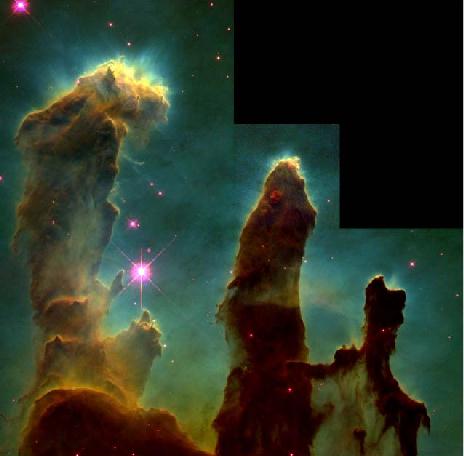
Perhaps the most famous astronomical image in recent years reveals newborn stars upon pillars of gas and dust - uncovered as researchers used the Hubble Space Telescope to explore the Eagle Nebula in 1995. This stunning picture provides a first hand glimpse of star birth as evaporating gaseous globules (EGGs) are captured emerging from pillars of molecular hydrogen gas and dust. These pillars, dubbed "elephant trunks," are light years in length and are so dense that interior gas gravitationally contracts to form stars. At each pillars' end, the intense radiation of bright young stars causes low density gas to boil away, leaving stellar nurseries of dense EGGs exposed.