Nebula
A nebula is a giant cloud of gas (mostly hydrogen and helium) and cosmic dust situated between stars in the interstellar medium. Nebulae serve as sites of stellar birth and death—including emission nebulae that glow from ionized gas, reflection nebulae that scatter starlight, and dark nebulae that obscure background stars.
Source: science.nasa.gov
APODs including "Nebula"
The Red Spider Planetary Nebula
06/01/1998
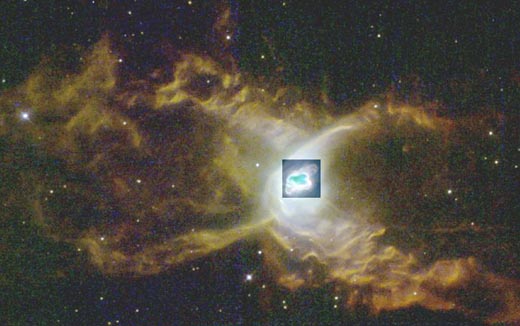
Oh what a tangled web a planetary nebula can weave. The Red Spider Planetary Nebula shows the complex structure that can result when a normal star ejects its outer gases and becomes a white dwarf star. Officially tagged NGC 6537, this two-lobed symmetric nebula houses one of the hottest white dwarfs ever observed, probably as part of binary star system. Internal winds emanating from the central stars, shown in the central inset, have been measured in excess of 300 kilometers per second. These hot winds expand the nebula, flow along the nebula's walls, and cause gas and dust to collide. Atoms caught in these colliding shocks radiate light shown in the above representative-light picture.