Nebula
A nebula is a giant cloud of gas (mostly hydrogen and helium) and cosmic dust situated between stars in the interstellar medium. Nebulae serve as sites of stellar birth and death—including emission nebulae that glow from ionized gas, reflection nebulae that scatter starlight, and dark nebulae that obscure background stars.
Source: science.nasa.gov
APODs including "Nebula"
NGC 6369: A Donut Shaped Nebula
18/05/1998
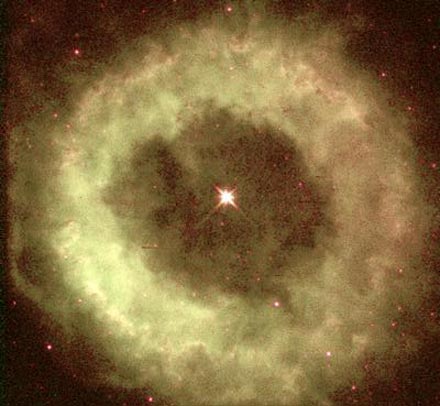
Why isn't the star in the center of the nebula? NGC 6369 appears to be a fairly ordinary planetary nebula. It can be seen with a good telescope in the constellation of Ophiuchus. The gas expelled by the central star is bunched in the shape of a donut or cylinder. During the planetary nebula phase, the central star sheds its outer atmosphere as it is evolving to become a white dwarf star. The above image was taken with the Hubble Space Telescope. A closer look at NGC 6369 indicates that the central star is closer to a dimmer edge of the nebula than to the opposing brighter edge.