Nebula
A nebula is a giant cloud of gas (mostly hydrogen and helium) and cosmic dust situated between stars in the interstellar medium. Nebulae serve as sites of stellar birth and death—including emission nebulae that glow from ionized gas, reflection nebulae that scatter starlight, and dark nebulae that obscure background stars.
Source: science.nasa.gov
APODs including "Nebula"
NGC 7635: The Bubble Nebula
18/01/2000
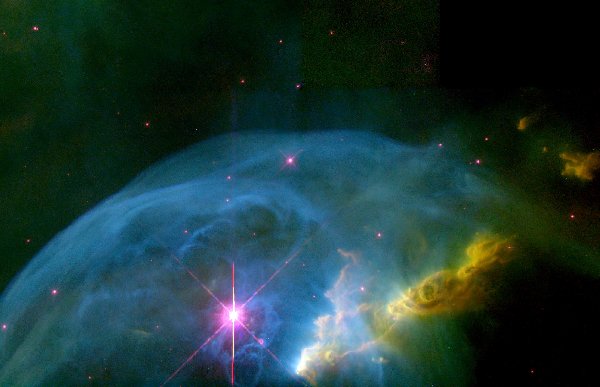
What created this huge space bubble? A massive star that is not only bright and blue, but also emitting a fast stellar wind of ionized gas. The Bubble Nebula is actually the smallest of three bubbles surrounding massive star BD+602522, and part of gigantic bubble network S162 created with the help of other massive stars. As fast moving gas expands off BD+602522, it pushes surrounding sparse gas into a shell. The energetic starlight then ionizes the shell, causing it to glow. The above picture taken with the Hubble Space Telescope and released last week shows many details of the Bubble Nebula never seen before and many still not understood. The nebula, also known as NGC 7635, is about six light-years across and visible with a small telescope towards the constellation of Cassiopeia.