Nebula
A nebula is a giant cloud of gas (mostly hydrogen and helium) and cosmic dust situated between stars in the interstellar medium. Nebulae serve as sites of stellar birth and death—including emission nebulae that glow from ionized gas, reflection nebulae that scatter starlight, and dark nebulae that obscure background stars.
Source: science.nasa.gov
APODs including "Nebula"
M63: The Sunflower Galaxy
27/06/2000
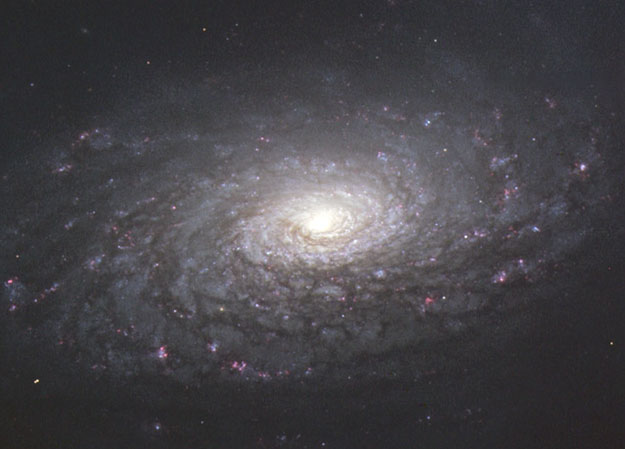
One of the bright spiral galaxies visible in the north sky is M63, the Sunflower Galaxy. M63, also catalogued as NGC 5055, can be found with a small telescope in the constellation of Canes Venaciti. Visible in the above picture are long winding spiral arms glowing blue from a few bright young stars, emission nebulae glowing red from hot ionized hydrogen gas, and dark dust in numerous filaments. M63 interacts gravitationally with M51 (the Whirlpool Galaxy) and several smaller galaxies. Light takes about 35 million years to reach us from M63, and about 60,000 years to cross the Sb-type spiral galaxy. Stars in the outer regions of the Sunflower Galaxy rotate about the center at a speed so high they should fly off into space, indicating that some sort of invisible, gravitationally-binding, dark matter is present.