Nebula
A nebula is a giant cloud of gas (mostly hydrogen and helium) and cosmic dust situated between stars in the interstellar medium. Nebulae serve as sites of stellar birth and death—including emission nebulae that glow from ionized gas, reflection nebulae that scatter starlight, and dark nebulae that obscure background stars.
Source: science.nasa.gov
APODs including "Nebula"
Pulsar Wind in the Vela Nebula
19/07/2001
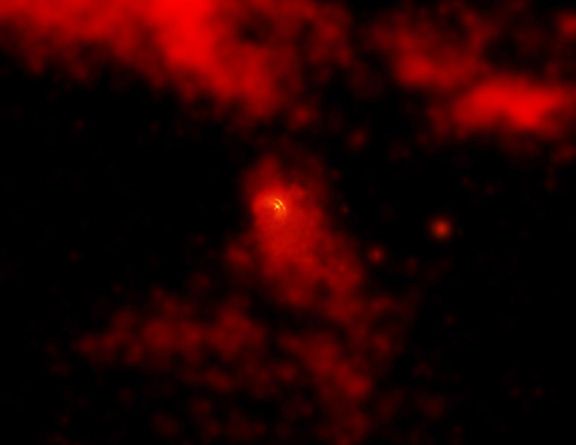
The Vela pulsar was born 10,000 years ago at the center of a supernova -- an exploding star. In this Chandra Observatory x-ray image, the pulsar still produces a glowing nebula at the heart of the expanding cloud of stellar debris. The pulsar itself is a neutron star, formed as the stellar core was compacted to nuclear densities. With a strong magnetic field, approximately the mass of the Sun, and a diameter of about 20 kilometers, the Vela pulsar rotates 11 times a second. The sharp Chandra image aids astronomers in understanding such extreme systems as efficient high-voltage generators which drive structured winds of electrically charged particles. An x-ray bright nebula is created as the pulsar winds slam into the surrounding material. This view spans about 6 light-years across the central region of the much larger Vela supernova remnant.