Nebula
A nebula is a giant cloud of gas (mostly hydrogen and helium) and cosmic dust situated between stars in the interstellar medium. Nebulae serve as sites of stellar birth and death—including emission nebulae that glow from ionized gas, reflection nebulae that scatter starlight, and dark nebulae that obscure background stars.
Source: science.nasa.gov
APODs including "Nebula"
The Crab Nebula Pulsar Shrugs
20/09/2002
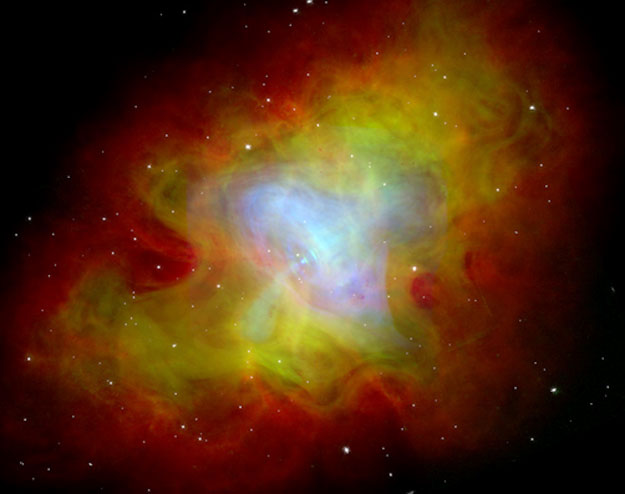
How does a city-sized neutron star power the vast Crab Nebula? The expulsion of wisps of hot gas at high speeds appears to be at least part of the answer. Yesterday time-lapse movies taken from both the Chandra X-ray Observatory and the Hubble Space Telescope were released showing a wisp of gas moving out at about half the speed of light. Wisps like this likely result from tremendous electric voltages created by the central pulsar, a rapidly rotating, magnetized, central neutron star. The hot plasma strikes existing gas, causing it glow in colors across the electromagnetic spectrum. Pictured above is a composite image of the center of the Crab Nebula where red represents radio emission, green represents visible emission, and blue represents X-ray emission. The dot at the very center is the hot pulsar spinning 30 times per second.