Nebula
A nebula is a giant cloud of gas (mostly hydrogen and helium) and cosmic dust situated between stars in the interstellar medium. Nebulae serve as sites of stellar birth and death—including emission nebulae that glow from ionized gas, reflection nebulae that scatter starlight, and dark nebulae that obscure background stars.
Source: science.nasa.gov
APODs including "Nebula"
Colorful Clouds of Orion
20/12/2002
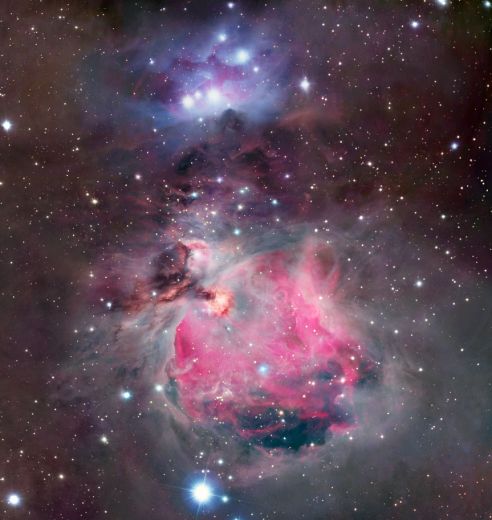
Revisiting one of the most famous nebulae in planet Earth's night sky, astrophotographer Robert Gendler has constructed this stunning, color-enhanced mosaic of the region surrounding the Great Nebula in Orion. As seen here, the clouds of Orion are dominated by the reddish emission nebula M42 near the bottom of the image, with blue reflection nebulae, including NGC 1977, near the top. Strewn with dust lanes and dark nebulae, the striking cosmic apparitions surrounding Orion's stellar nurseries are about 1,500 light-years away and are themselves several light-years across. Located at the edge of a giant molecular cloud complex spanning hundreds of light-years, these nebulae represent only a small, but very visible(!), fraction of this region's wealth of interstellar material. Within these colorful clouds of Orion, astronomers have also identified what appear to be numerous infant solar systems.