Nebula
A nebula is a giant cloud of gas (mostly hydrogen and helium) and cosmic dust situated between stars in the interstellar medium. Nebulae serve as sites of stellar birth and death—including emission nebulae that glow from ionized gas, reflection nebulae that scatter starlight, and dark nebulae that obscure background stars.
Source: science.nasa.gov
APODs including "Nebula"
A Crescent Nebula Star Field
15/04/2003
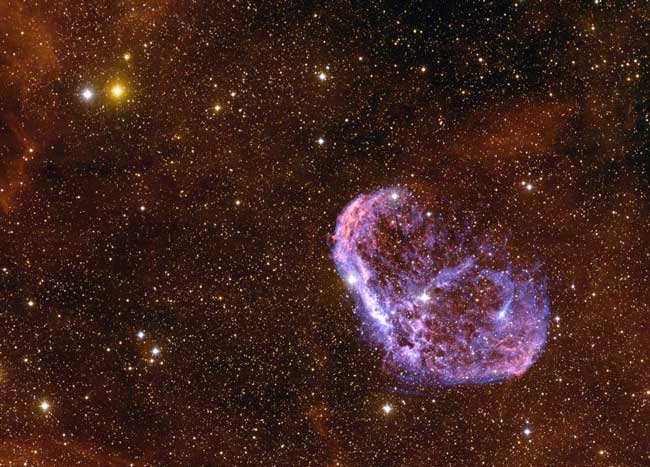
What caused the Crescent Nebula? Looking like an emerging space cocoon, the Crescent Nebula, visible on the right, was created by the brightest star in its center. A leading progenitor hypothesis has the Crescent Nebula beginning to form about 250,000 years ago. At that time, the massive central star had evolved to become a Wolf-Rayet star (WR 136), shedding its outer envelope in a strong stellar wind, ejecting the equivalent of our Sun's mass every 10,000 years. This wind impacted surrounding gas left over from a previous phase, compacting it into a series of complex shells, and lighting it up. The Crescent Nebula, also known as NGC 6888, lies about 4,700 light-years away in the constellation of Cygnus. Star WR 136 will probably undergo a supernova explosion sometime in the next million years.