Nebula
A nebula is a giant cloud of gas (mostly hydrogen and helium) and cosmic dust situated between stars in the interstellar medium. Nebulae serve as sites of stellar birth and death—including emission nebulae that glow from ionized gas, reflection nebulae that scatter starlight, and dark nebulae that obscure background stars.
Source: science.nasa.gov
APODs including "Nebula"
Young Star, Dark Cloud
26/12/2003
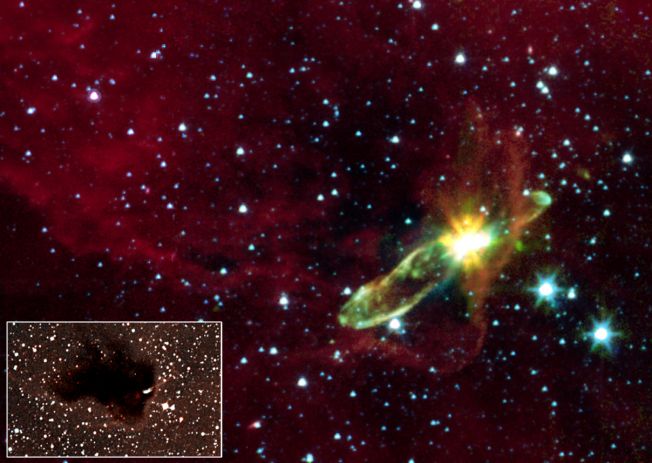
High-speed outflows of molecular gas from a young stellar object glow in infrared light, revealing themselves in this recent false-color image from the Spitzer Space Telescope. Cataloged as HH (Herbig-Haro) 46/47 the infrared source is lodged within a dark nebula or Bok globule - near the lower right corner of the dark nebula in the optical inset - that is largely opaque when viewed in visible light. The energetic outflow features extend for nearly a light-year, burrowing into the dark interstellar material, and are attributed to early stages in the life of a sun-like star. They may well represent a phase of our own Sun's evolution which took place some 4.5 billion years ago, along with the formation of our solar system from a circumstellar disk. A tantalizing object to explore with Spitzer's infrared capabilities, this young star system is relatively nearby, located only some 1,140 light-years distant in the nautical constellation Vela.