Nebula
A nebula is a giant cloud of gas (mostly hydrogen and helium) and cosmic dust situated between stars in the interstellar medium. Nebulae serve as sites of stellar birth and death—including emission nebulae that glow from ionized gas, reflection nebulae that scatter starlight, and dark nebulae that obscure background stars.
Source: science.nasa.gov
APODs including "Nebula"
Unusual Spiral Galaxy M66
07/04/2004
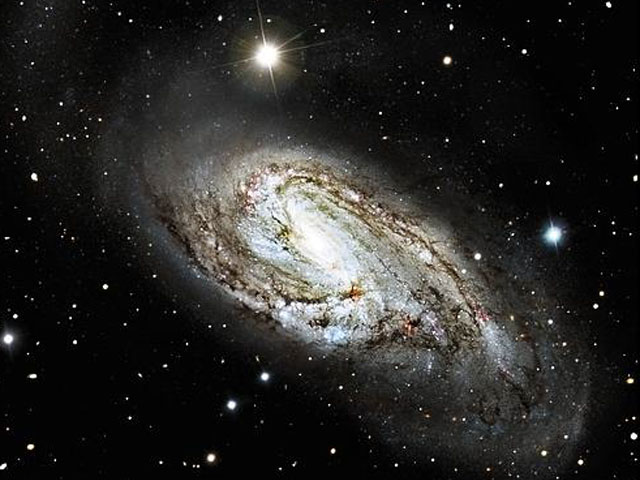
Why isn't spiral galaxy M66 symmetric? Usually density waves of gas, dust, and newly formed stars circle a spiral galaxy's center and create a nearly symmetric galaxy. The differences between M66's spiral arms and the apparent displacement of its nucleus are all likely caused by the tidal gravitational pull of nearby galaxy neighbor M65. Spiral galaxy M66, pictured above, spans about 100,000 light years, lies about 35 million light years distant, and is the largest galaxy in a group including M65 and NGC 3628 known as the Leo Triplet. Like many spiral galaxies, the long and intricate dust lanes of M66 are seen intertwined with the bright stars and nebulas that light up the spiral arms.