Nebula
A nebula is a giant cloud of gas (mostly hydrogen and helium) and cosmic dust situated between stars in the interstellar medium. Nebulae serve as sites of stellar birth and death—including emission nebulae that glow from ionized gas, reflection nebulae that scatter starlight, and dark nebulae that obscure background stars.
Source: science.nasa.gov
APODs including "Nebula"
N11: A Giant Ring of Emission Nebulas
06/10/2004
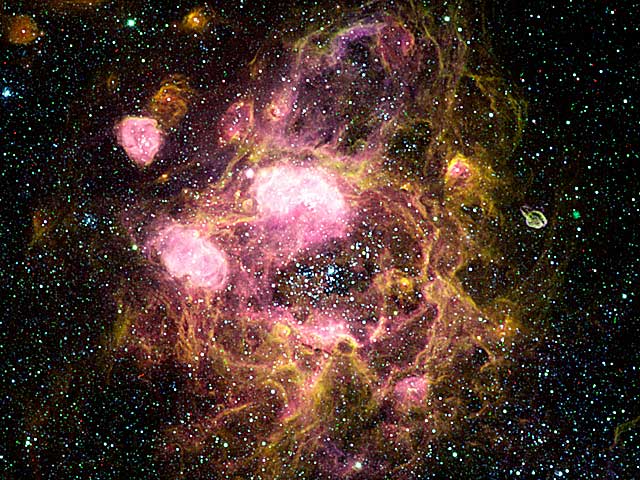
How did this unusually large nebula form? One of the largest nebulas yet detected is actually a complex ring of emission nebulas connected by glowing filaments. The unusual network, known as N11, spans over 1000 light years and is a prominent structure of the Large Magellanic Cloud, the largest satellite galaxy of our Milky Way Galaxy. In the center of the above image is open star cluster LH9, also known as NGC 1760, composed of about 50 bright blue stars that emit radiation that has eroded a hole in their surroundings. A leading hypothesis for the formation of N11 is shells of successive generations of stars being formed further out from the center. The bright region just above center is N11B, an explosive domain where stars are being formed even today.