Nebula
A nebula is a giant cloud of gas (mostly hydrogen and helium) and cosmic dust situated between stars in the interstellar medium. Nebulae serve as sites of stellar birth and death—including emission nebulae that glow from ionized gas, reflection nebulae that scatter starlight, and dark nebulae that obscure background stars.
Source: science.nasa.gov
APODs including "Nebula"
UKIRT: Aloha Orion
06/01/2005
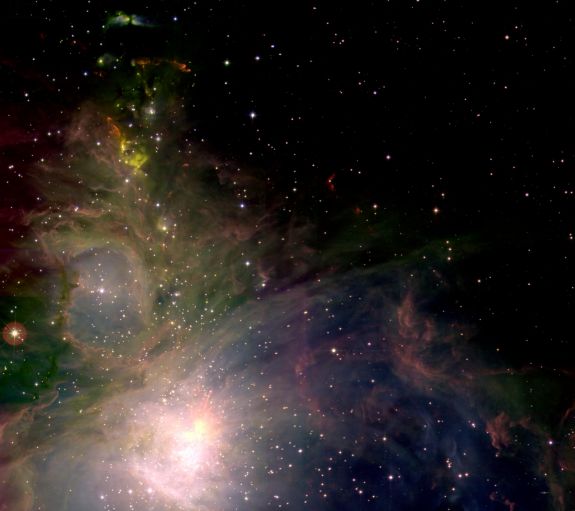
At the edge of a dense molecular cloud, filaments of gas, cosmic dust, and a multitude of young stars beckon in this penetrating image of the Orion Nebula. Alluring structures in the well-known star forming region are revealed here in infrared light as viewed by a new Hawaiian eye - WFCAM - a powerful wide field camera commissioned at the United Kingdom Infrared Telescope (UKIRT) on Mauna Kea. Only a fraction of WFCAM's full field, this picture covers about 11 light-years at the 1,500 light-year distance of the nebula. In the image, otherwise invisible infrared light has been mapped into visible colors. Red represents narrow-band infrared emission from hydrogen molecules at a wavelength of 2.12 microns, green is emission at 2.2 microns, and blue is emission at 1.25 microns. Visible light has a wavelength of about 0.5 microns (micrometers).