Nebula
A nebula is a giant cloud of gas (mostly hydrogen and helium) and cosmic dust situated between stars in the interstellar medium. Nebulae serve as sites of stellar birth and death—including emission nebulae that glow from ionized gas, reflection nebulae that scatter starlight, and dark nebulae that obscure background stars.
Source: science.nasa.gov
APODs including "Nebula"
Composite Crab
26/03/2005
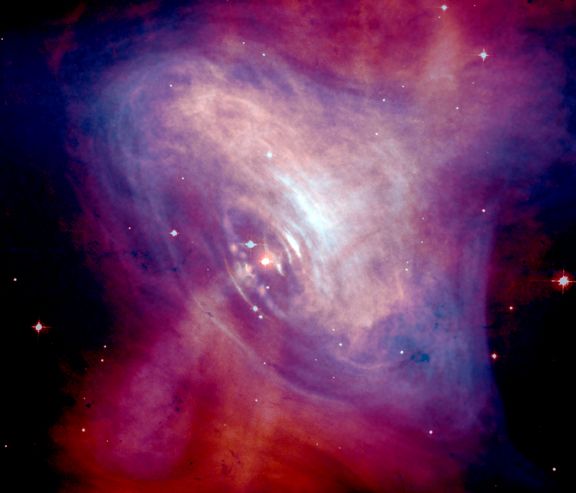
The Crab Pulsar, a city-sized, magnetized neutron star spinning 30 times a second, lies at the center of this composite image of the inner region of the well-known Crab Nebula. The spectacular picture combines optical data (red) from the Hubble Space Telescope and x-ray images (blue) from the Chandra Observatory, also used in the popular Crab Pulsar movies. Like a cosmic dynamo the pulsar powers the x-ray and optical emission from the nebula, accelerating charged particles and producing the eerie, glowing x-ray jets. Ring-like structures are x-ray emitting regions where the high energy particles slam into the nebular material. The innermost ring is about a light-year across. With more mass than the Sun and the density of an atomic nucleus, the spinning pulsar is the collapsed core of a massive star that exploded, while the nebula is the expanding remnant of the star's outer layers. The supernova explosion was witnessed in the year 1054.