Nebula
A nebula is a giant cloud of gas (mostly hydrogen and helium) and cosmic dust situated between stars in the interstellar medium. Nebulae serve as sites of stellar birth and death—including emission nebulae that glow from ionized gas, reflection nebulae that scatter starlight, and dark nebulae that obscure background stars.
Source: science.nasa.gov
APODs including "Nebula"
Swirls and Stars in IC 4678
24/05/2005
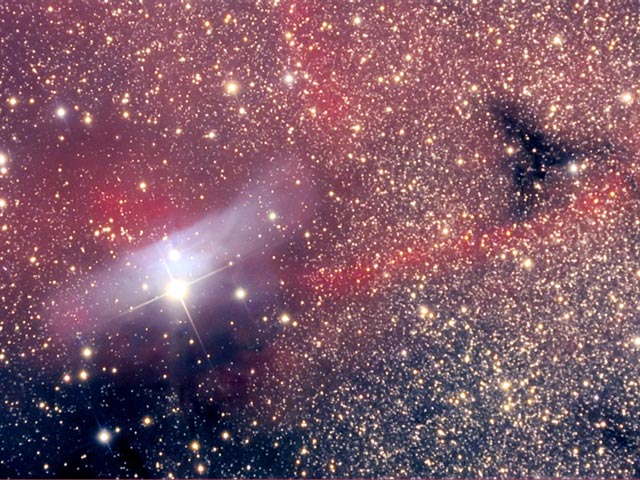
Swirls of gas and dust enrich this little observed starfield toward the constellation of Sagittarius. Just to the side of the more often photographed Lagoon Nebula (M8) and the Trifid Nebula (M20) lies this busy patch of sky dubbed IC 4678. Prominent in the above image are large emission nebulas of red glowing gas highlighted by unusually bright red filaments. On the left, a band of thin dust preferentially reflects the blue light of a bright star creating a small reflection nebula. On the right and across the bottom, swaths of thicker dust appear as dark absorption nebulas, blocking the light from stars farther in the distance. IC 4678 spans about 25 light years and lies about 5,000 light years distant.