Nebula
A nebula is a giant cloud of gas (mostly hydrogen and helium) and cosmic dust situated between stars in the interstellar medium. Nebulae serve as sites of stellar birth and death—including emission nebulae that glow from ionized gas, reflection nebulae that scatter starlight, and dark nebulae that obscure background stars.
Source: science.nasa.gov
APODs including "Nebula"
Sculpting the South Pillar
02/06/2005
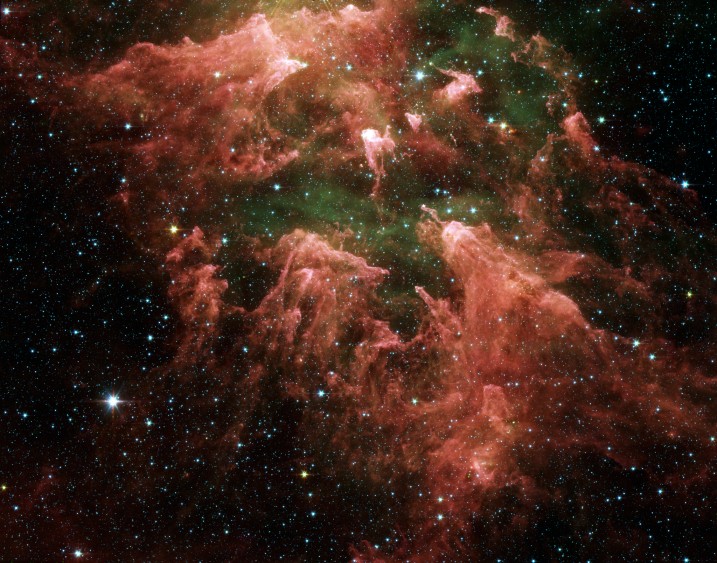
Carinae, one of the most massive and unstable stars in the Milky Way Galaxy, has a profound effect on its environment. Found in the the South Pillar region of the Carina Nebula, these fantastic pillars of glowing dust and gas with embedded newborn stars were sculpted by the intense wind and radiation from Eta Carinae and other massive stars. Glowing brightly in planet Earth's southern sky, the expansive Eta Carinae Nebula is a mere 10,000 light-years distant. Still, this remarkable cosmic vista is largely obscured by nebular dust and only revealed here in penetrating infrared light by the Spitzer Space Telescope. Eta Carinae itself is off the top left of the false-color image, with the bright-tipped dust pillars pointing suggestively toward the massive star's position. The Spitzer image spans almost 200 light-years at the distance of Eta Carinae.