Nebula
A nebula is a giant cloud of gas (mostly hydrogen and helium) and cosmic dust situated between stars in the interstellar medium. Nebulae serve as sites of stellar birth and death—including emission nebulae that glow from ionized gas, reflection nebulae that scatter starlight, and dark nebulae that obscure background stars.
Source: science.nasa.gov
APODs including "Nebula"
Infrared Helix
12/01/2006
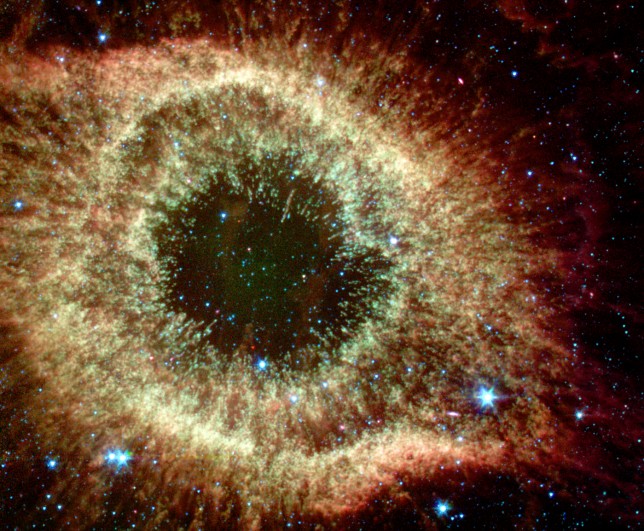
Over six hundred light years from Earth, in the constellation Aquarius, a sun-like star is dying. Its last few thousand years have produced the Helix Nebula (NGC 7293), a well studied and nearby example of a Planetary Nebula, typical of this final phase of stellar evolution. Emission in this infrared Spitzer Space Telescope image of the Helix comes mostly from the nebula's molecular hydrogen gas. The gas appears to be clumpy, forming thousands of comet-shaped knots each spanning about twice the size of our solar system. Bluer, more energetic radiation is seen to come from the heads with redder emission from the tails, suggesting that they are more shielded from the central star's winds and intense ultraviolet radiation. The nebula itself is about 2.5 light-years across. The Sun is expected to go through its own Planetary Nebula phase ... in another 5 billion years.