Nebula
A nebula is a giant cloud of gas (mostly hydrogen and helium) and cosmic dust situated between stars in the interstellar medium. Nebulae serve as sites of stellar birth and death—including emission nebulae that glow from ionized gas, reflection nebulae that scatter starlight, and dark nebulae that obscure background stars.
Source: science.nasa.gov
APODs including "Nebula"
M8: The Lagoon Nebula
10/02/2006
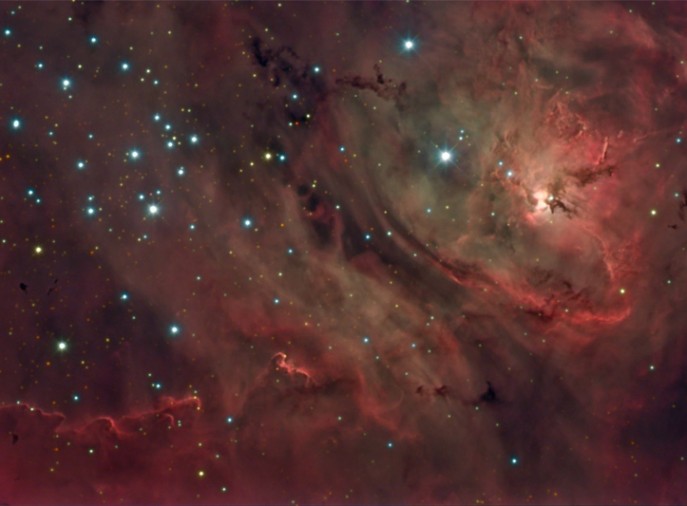
This beautiful cosmic cloud is a popular stop on telescopic tours of the constellation Sagittarius. Eighteenth century cosmic tourist Charles Messier cataloged the bright nebula as M8, while modern day astronomers recognize the Lagoon Nebula as an active stellar nursery about 5,000 light-years distant, in the direction of the center of our Milky Way Galaxy. Striking details can be traced through this remarkable picture, processed to reveal the Lagoon's range of filaments of glowing hydrogen gas and dark dust clouds along with the brighter, turbulent hourglass region at the upper right. The view is a color composite of narrow and broad band images recorded under dark skies in northwestern Arizona. At the Lagoon's estimated distance, the picture spans about 30 light-years.