Nebula
A nebula is a giant cloud of gas (mostly hydrogen and helium) and cosmic dust situated between stars in the interstellar medium. Nebulae serve as sites of stellar birth and death—including emission nebulae that glow from ionized gas, reflection nebulae that scatter starlight, and dark nebulae that obscure background stars.
Source: science.nasa.gov
APODs including "Nebula"
IC 4628: The Prawn Nebula
20/10/2006
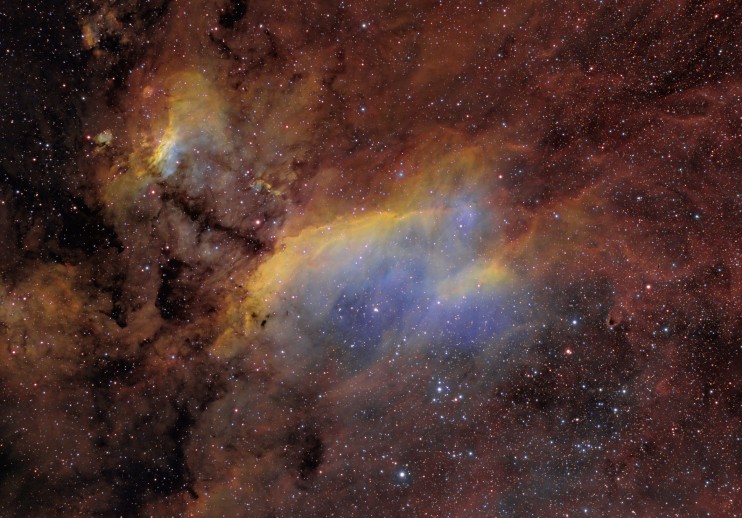
South of Antares, in the tail of the nebula-rich constellation Scorpius, lies emission nebula IC 4628. Nearby hot, massive stars, millions of years young, radiate the nebula with invisible ultraviolet light, stripping electrons from atoms. The electrons eventually recombine with the atoms to produce the visible nebular glow. This narrow band image adopts a typical false-color mapping of the atomic emission, showing hydrogen emission in green hues, sulfur as red and oxygen as blue. At an estimated distance of 6,000 light-years, the region shown is about 250 light-years across. The nebula is also cataloged as Gum 56 for Australian astronomer Colin Stanley Gum, but seafood-loving astronomers might know this cosmic cloud as The Prawn Nebula.