Nebula
A nebula is a giant cloud of gas (mostly hydrogen and helium) and cosmic dust situated between stars in the interstellar medium. Nebulae serve as sites of stellar birth and death—including emission nebulae that glow from ionized gas, reflection nebulae that scatter starlight, and dark nebulae that obscure background stars.
Source: science.nasa.gov
APODs including "Nebula"
NGC 2174: Emission Nebula in Orion
08/12/2006
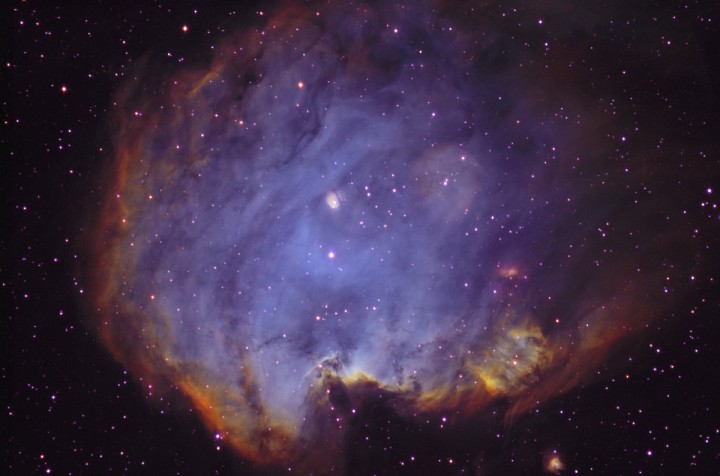
A lesser known sight in the nebula-rich constellation Orion, NGC 2174 can be found with binoculars near the head of the celestial hunter. About 6,400 light-years distant, the glowing cosmic cloud surrounds loose clusters of young stars. Covering an area larger than the full Moon on the sky, this stunning narrow band image adopts a typical color mapping of the atomic emission from NGC 2174. The false-color mapping shows otherwise red hydrogen emission in green hues and emphasizes sulfur emission in red and oxygen in blue. Placing your cursor on the image will reveal an alternative image of the nebula made through broad band filters. The broad band image combines filters in a closer analogy to human vision, dominated by the red glow of hydrogen.