Nebula
A nebula is a giant cloud of gas (mostly hydrogen and helium) and cosmic dust situated between stars in the interstellar medium. Nebulae serve as sites of stellar birth and death—including emission nebulae that glow from ionized gas, reflection nebulae that scatter starlight, and dark nebulae that obscure background stars.
Source: science.nasa.gov
APODs including "Nebula"
The Tulip in the Swan
24/05/2007
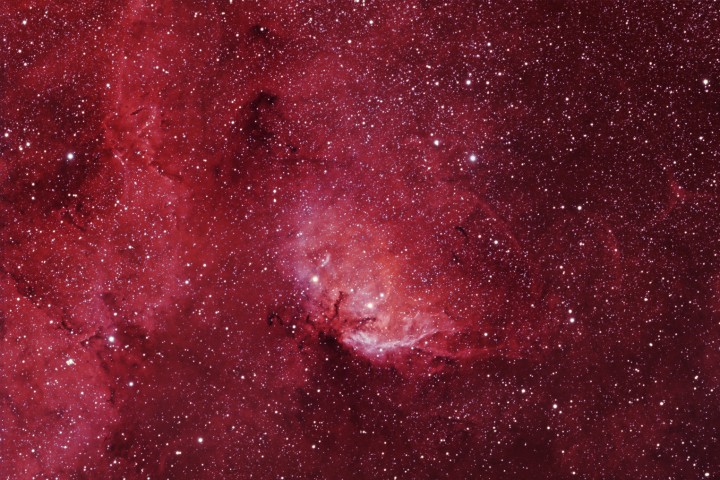
This expansive (1-degree wide) telescopic view looks out along the plane of our Milky Way Galaxy toward the nebula rich constellation Cygnus the Swan. It is centered on a bright hydrogen emission region recorded in the 1959 catalog by astronomer Stewart Sharpless as Sh2-101. About 8,000 light-years distant the nebula is popularly known as the Tulip Nebula, understandably not the only cosmic cloud to evoke the imagery of flowers. Complex and beautiful in visible light, the area also includes one of the brightest, most famous sources in the x-ray sky, Cygnus X-1. Discovered in the early 1970s, Cygnus X-1 is a bizarre binary system consisting of a massive, hot, supergiant star (seen here) in close orbit with a stellar mass black hole. The Cygnus X-1 system is also estimated to lie a comfortable 8,000 light-years away.