Nebula
A nebula is a giant cloud of gas (mostly hydrogen and helium) and cosmic dust situated between stars in the interstellar medium. Nebulae serve as sites of stellar birth and death—including emission nebulae that glow from ionized gas, reflection nebulae that scatter starlight, and dark nebulae that obscure background stars.
Source: science.nasa.gov
APODs including "Nebula"
Long Stem Rosette
14/02/2008
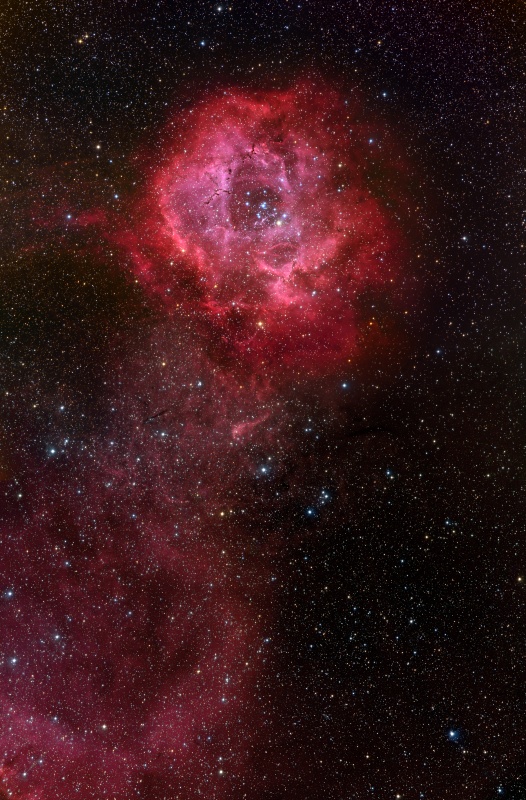
The Rosette Nebula (aka NGC 2237) is not the only cosmic cloud of gas and dust to evoke the imagery of flowers. But it is the one most often suggested as a suitable astronomy image for Valentine's Day. Of the many excellent Rosette Nebula pictures submitted to APOD editors, this view seemed most appropriate, with a long stem of glowing hydrogen gas in the region included in the composition. At the edge of a large molecular cloud in Monoceros, some 5,000 light years away, the petals of this rose are actually a stellar nursery whose lovely, symmetric shape is sculpted by the winds and radiation from its central cluster of hot young stars. The stars in the energetic cluster, cataloged as NGC 2244, are only a few million years old, while the central cavity in the Rosette Nebula is about 50 light-years in diameter. Happy Valentine's Day!