Nebula
A nebula is a giant cloud of gas (mostly hydrogen and helium) and cosmic dust situated between stars in the interstellar medium. Nebulae serve as sites of stellar birth and death—including emission nebulae that glow from ionized gas, reflection nebulae that scatter starlight, and dark nebulae that obscure background stars.
Source: science.nasa.gov
APODs including "Nebula"
The N44 Complex
27/03/2008
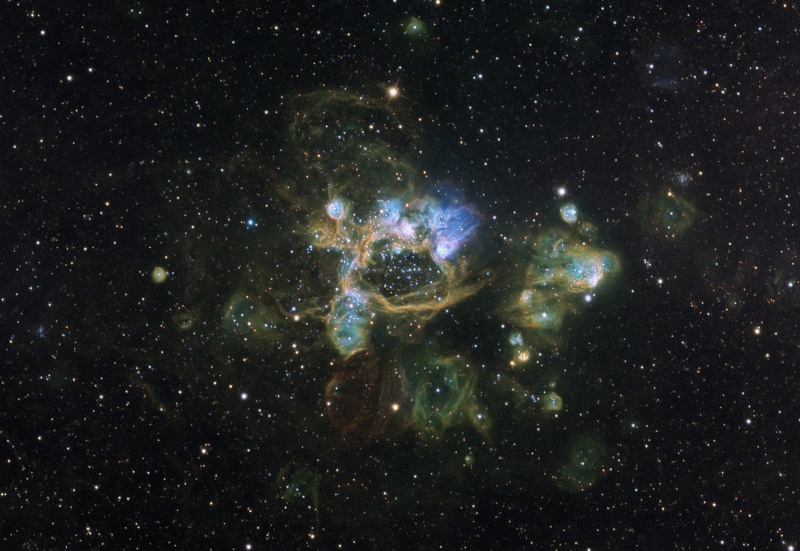
A truly giant complex of emission nebulae, N44 is about 1,000 light-years across. It shines in southern skies as a denizen of our neighboring galaxy, the Large Magellanic Cloud, 170,000 light-years away. Winds and intense radiation from hot, young, luminous stars in N44 excite and sculpt filaments and streamers of the glowing nebular gas. But supernovae - the death explosions of the massive short lived stars - have also likely contributed to the region's enormous, blown-out shapes. The cluster of young stars seen near the center lies in a superbubble nearly 250 light-years across. This detailed, false-color view of the intricate structures codes emission from hydrogen, oxygen, and sulfur in shades of blue and green.