Nebula
A nebula is a giant cloud of gas (mostly hydrogen and helium) and cosmic dust situated between stars in the interstellar medium. Nebulae serve as sites of stellar birth and death—including emission nebulae that glow from ionized gas, reflection nebulae that scatter starlight, and dark nebulae that obscure background stars.
Source: science.nasa.gov
APODs including "Nebula"
Great Orion Nebulae
23/10/2008
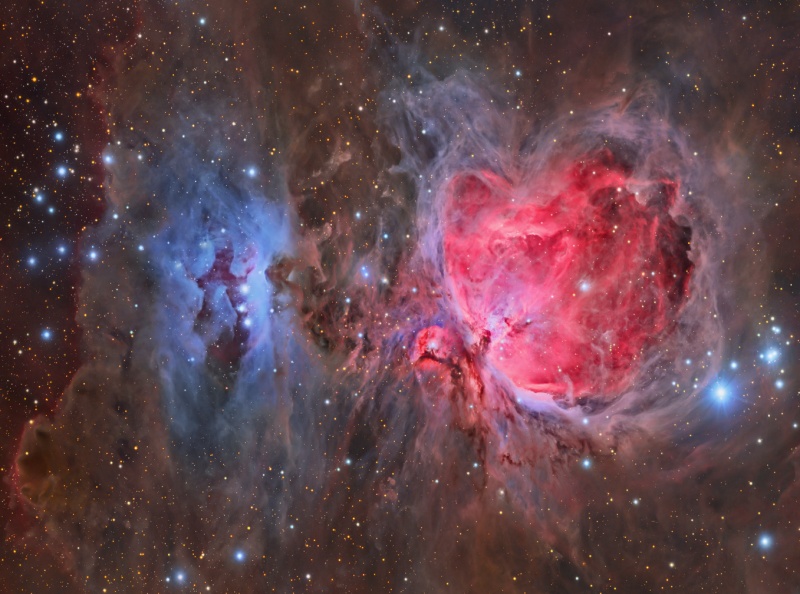
The Great Nebula in Orion, also known as M42, is one of the most famous nebulae in the sky. The star forming region's glowing gas clouds and hot young stars are on the right in this sharp and colorful two frame mosaic that includes the smaller nebula M43 near center and dusty, bluish reflection nebulae NGC 1977 and friends on the left. Located at the edge of an otherwise invisible giant molecular cloud complex, these eye-catching nebulae represent only a small fraction of this galactic neighborhood's wealth of interstellar material. Within the well-studied stellar nursery, astronomers have also identified what appear to be numerous infant solar systems. The gorgeous skyscape spans nearly two degrees or about 45 light-years at the Orion Nebula's estimated distance of 1,500 light-years. Editor's Note: A version of the image with labels generated by Astrometry.net is available here.