Nebula
A nebula is a giant cloud of gas (mostly hydrogen and helium) and cosmic dust situated between stars in the interstellar medium. Nebulae serve as sites of stellar birth and death—including emission nebulae that glow from ionized gas, reflection nebulae that scatter starlight, and dark nebulae that obscure background stars.
Source: science.nasa.gov
APODs including "Nebula"
The Large Cloud of Magellan
19/12/2008
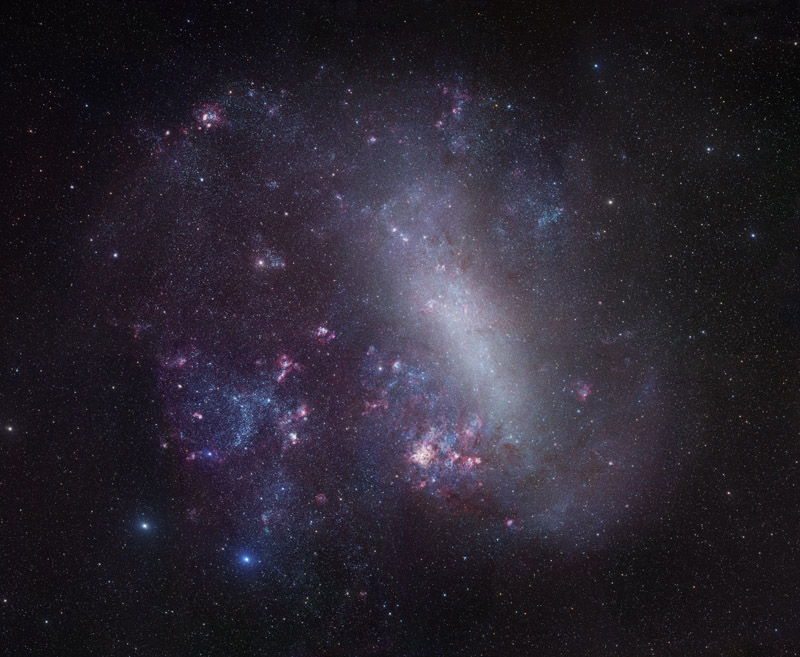
The 16th century Portuguese navigator Ferdinand Magellan and his crew had plenty of time to study the southern sky during the first circumnavigation of planet Earth. As a result, two fuzzy cloud-like objects easily visible to southern hemisphere skygazers are known as the Clouds of Magellan, now understood to be satellite galaxies of our much larger, spiral Milky Way galaxy. About 160,000 light-years distant in the constellation Dorado, the Large Magellanic Cloud (LMC) is seen here in a remarkably detailed, 10 frame mosaic image. Spanning about 30,000 light-years or so, it is the most massive of the Milky Way's satellite galaxies and is the site of the closest supernova in modern times, SN 1987A. The prominent reddish knot near the bottom is 30 Doradus, or the Tarantula Nebula, a giant star-forming region in the Large Magellanic Cloud. To identify the location of the supernova and navigate your way around the many star clusters and nebulae of the LMC, just consult this well-labeled view.