Nebula
A nebula is a giant cloud of gas (mostly hydrogen and helium) and cosmic dust situated between stars in the interstellar medium. Nebulae serve as sites of stellar birth and death—including emission nebulae that glow from ionized gas, reflection nebulae that scatter starlight, and dark nebulae that obscure background stars.
Source: science.nasa.gov
APODs including "Nebula"
Barnard's Loop around the Horsehead Nebula
24/02/2009
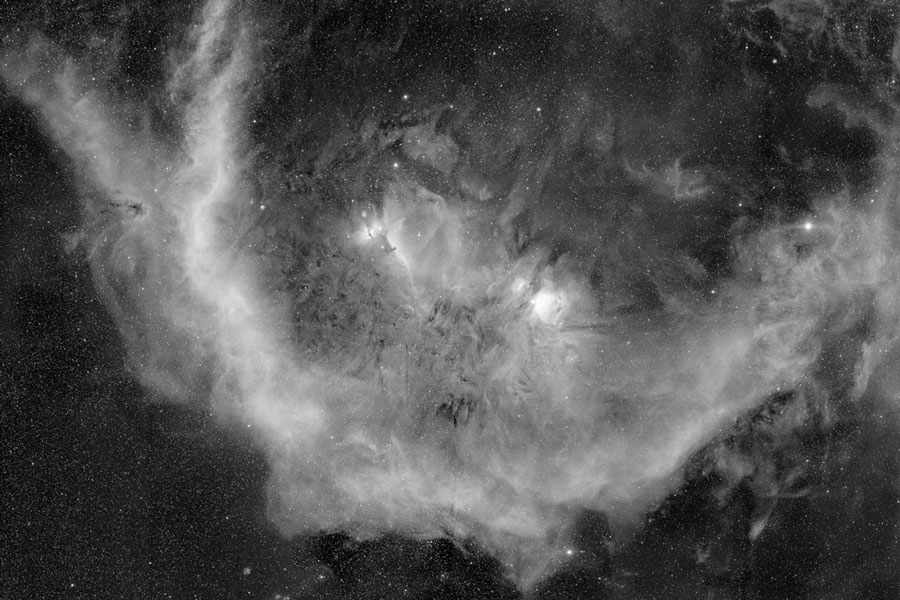
Why is the Horsehead Nebula surrounded by a bubble? Although hard to make out, the famous Horsehead Nebula is the slight dark indentation in the bright streak just to the left of the image center. Glowing like an emission nebula, the origin of the bubble, known as Barnard's Loop, is currently unknown. Progenitor hypotheses include the winds from bright Orion stars and the supernovas of stars long gone. Barnard's Loop is too faint to be identified with the unaided eye. The nebula was discovered only in 1895 by E. E. Barnard on long duration film exposures. The above image was taken in a single specific color emitted by hydrogen to bring out detail. To the left of the Horsehead Nebula, visible as a small dark indentation, is the photogenic Flame Nebula.