Nebula
A nebula is a giant cloud of gas (mostly hydrogen and helium) and cosmic dust situated between stars in the interstellar medium. Nebulae serve as sites of stellar birth and death—including emission nebulae that glow from ionized gas, reflection nebulae that scatter starlight, and dark nebulae that obscure background stars.
Source: science.nasa.gov
APODs including "Nebula"
A Pulsar's Hand
01/05/2010
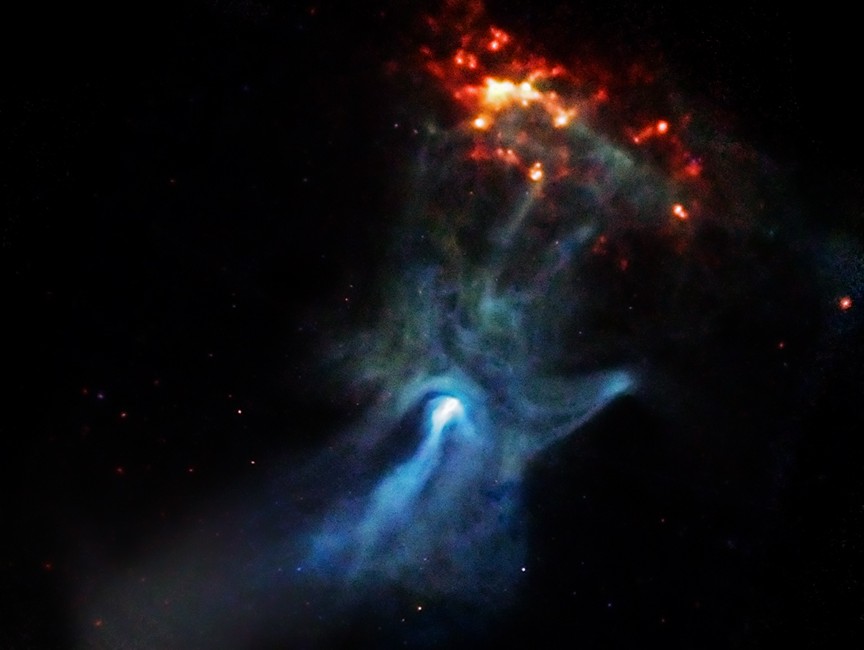
As far as pulsars go, PSR B1509-58 appears young. Light from the supernova explosion that gave birth to it would have first reached Earth some 1,700 years ago. The magnetized, 20 kilometer-diameter neutron star spins 7 times per second, a cosmic dynamo that powers a wind of charged particles. The energetic wind creates the surrounding nebula's X-ray glow in this tantalizing image from the Chandra X-ray Observatory. Low energy X-rays are in red, medium energies in green, and high energies in blue. The pulsar itself is in the bright central region. Remarkably, the nebula's tantalizing, complicated structure resembles a hand. PSR B1509-58 is about 17,000 light-years away in the southern constellation Circinus. At that distance the Chandra image spans 100 light-years.