Nebula
A nebula is a giant cloud of gas (mostly hydrogen and helium) and cosmic dust situated between stars in the interstellar medium. Nebulae serve as sites of stellar birth and death—including emission nebulae that glow from ionized gas, reflection nebulae that scatter starlight, and dark nebulae that obscure background stars.
Source: science.nasa.gov
APODs including "Nebula"
IRAS 05437+2502: An Enigmatic Star Cloud from Hubble
09/08/2010
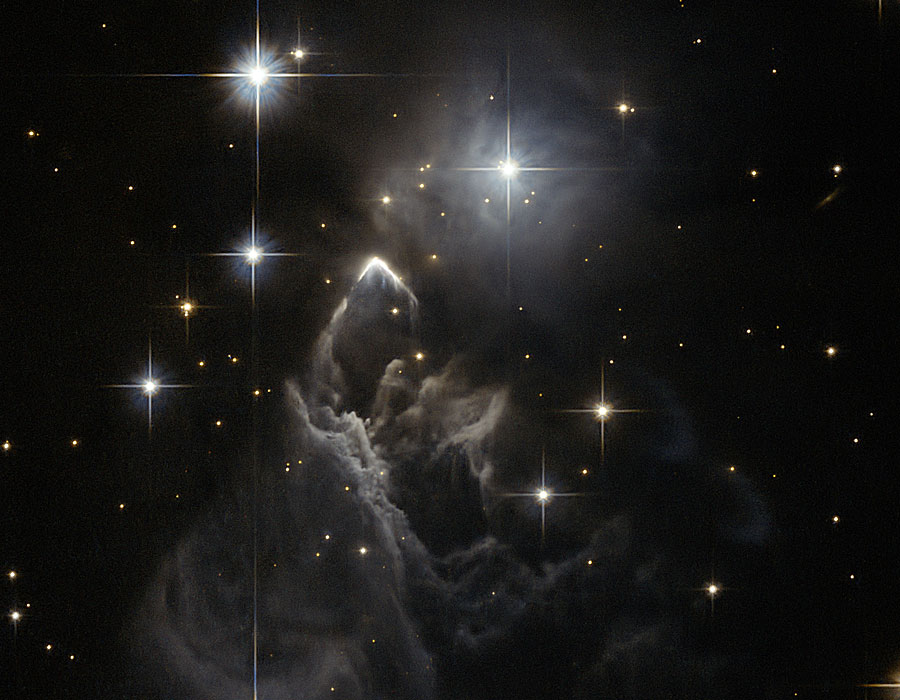
What's lighting up nebula IRAS 05437+2502? No one is sure. Particularly enigmatic is the bright upside-down V that defines the upper edge of this floating mountain of interstellar dust, visible near the image center. In general, this ghost-like nebula involves a small star forming region filled with dark dust that was first noted in images taken by the IRAS satellite in infrared light in 1983. Shown above is a spectacular, recently released image from the Hubble Space Telescope that, although showing many new details, has not uncovered a clear cause of the bright sharp arc. One hypothesis holds that the glowing arc was created by a massive star that somehow attained a high velocity and has now left the nebula. Small, faint IRAS 05437+2502 spans only 1/18th of a full moon toward the constellation of the Bull (Taurus).