Nebula
A nebula is a giant cloud of gas (mostly hydrogen and helium) and cosmic dust situated between stars in the interstellar medium. Nebulae serve as sites of stellar birth and death—including emission nebulae that glow from ionized gas, reflection nebulae that scatter starlight, and dark nebulae that obscure background stars.
Source: science.nasa.gov
APODs including "Nebula"
Stardust in Aries
25/11/2010
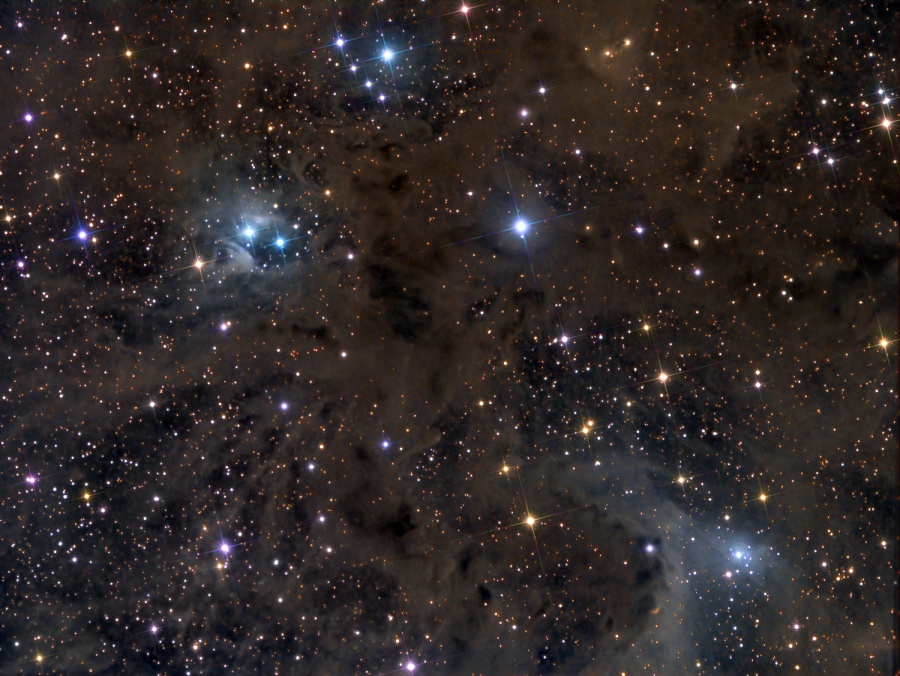
This composition in stardust covers almost 2 degrees on the sky, close to the border of the zodiacal constellation Aries and the plane of our Milky Way Galaxy. At the lower right of the gorgeous skyscape is a dusty blue reflection nebula surrounding a bright star cataloged as van den Bergh 13 (vdB 13), about 1,000 light-years away. At that estimated distance, the cosmic canvas is over 30 light-years across. Also surrounded by scattered blue starlight, vdB 16 lies toward the upper left, while dark dusty nebulae sprawl across the scene. Near the edge of a large molecular cloud, they can hide newly formed stars and young stellar objects or protostars from prying optical telescopes. Collapsing due to self-gravity, the protostars form around dense cores embedded in the molecular cloud.