Nebula
A nebula is a giant cloud of gas (mostly hydrogen and helium) and cosmic dust situated between stars in the interstellar medium. Nebulae serve as sites of stellar birth and death—including emission nebulae that glow from ionized gas, reflection nebulae that scatter starlight, and dark nebulae that obscure background stars.
Source: science.nasa.gov
APODs including "Nebula"
Stardust and Betelgeuse
28/06/2011
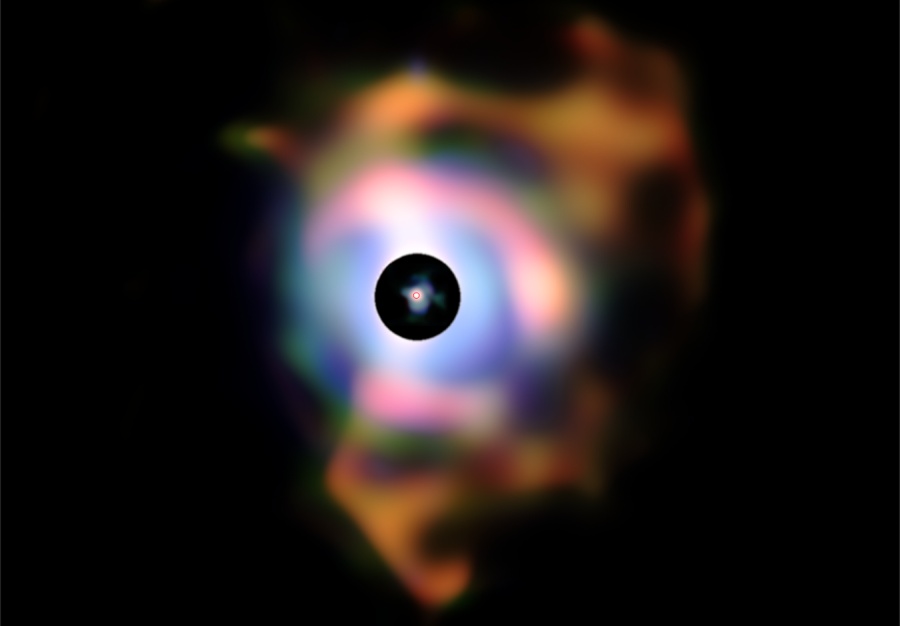
An expansive nebula of dust is seen to surround red supergiant star Betegeuse in this remarkable high resolution composite, an infrared VLT image from the European Southern Observatory. Betelgeuse itself is outlined by the small, central red circle. If found in our own solar system its diameter would almost encompass the orbit of Jupiter. But the larger envelope of circumstellar dust extends some 60 billion kilometers into space, equivalent to about 400 times the Earth-Sun distance. The dust is likely formed as the swollen atmosphere of the supergiant sheds material into space, a final phase in the evolution of a massive star. Mixing with the interstellar medium, the dust could ultimately form rocky terrestrial planets like Earth. The central bright portion of the outer image has been masked to reveal fainter extended structures. The field of view is 5.63 arcseconds across.