Nebula
A nebula is a giant cloud of gas (mostly hydrogen and helium) and cosmic dust situated between stars in the interstellar medium. Nebulae serve as sites of stellar birth and death—including emission nebulae that glow from ionized gas, reflection nebulae that scatter starlight, and dark nebulae that obscure background stars.
Source: science.nasa.gov
APODs including "Nebula"
Barred Spiral Galaxy NGC 1073
20/02/2012
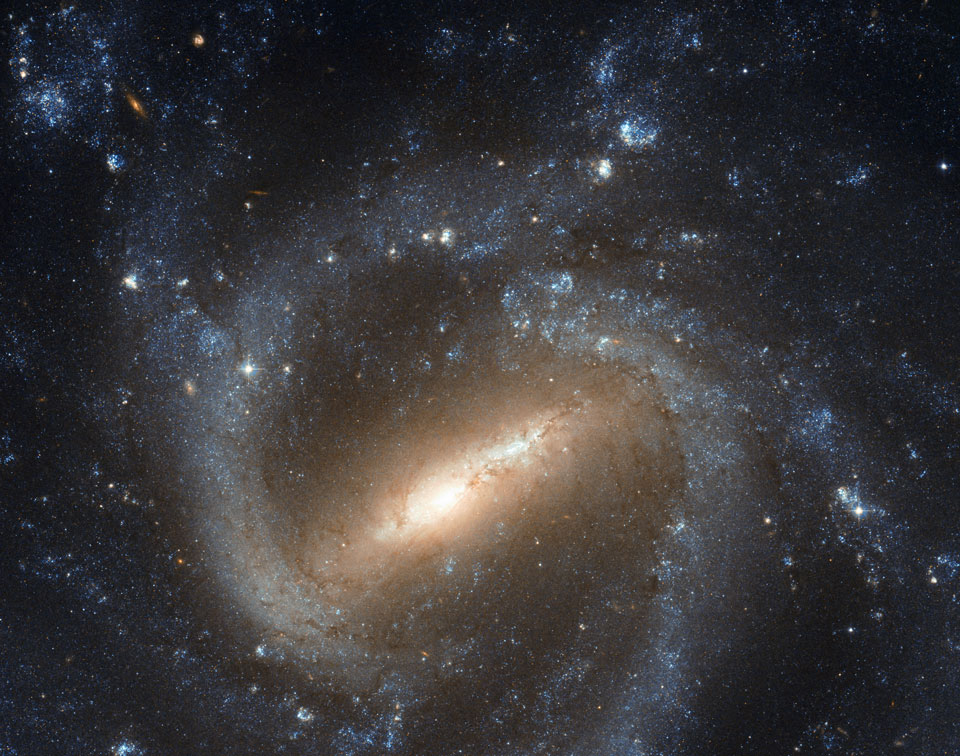
Many spiral galaxies have bars across their centers. Even our own Milky Way Galaxy is thought to have a modest central bar. Prominently barred spiral galaxy NGC 1073, pictured above, was captured in spectacular detail in this recently released image taken by the orbiting Hubble Space Telescope. Visible are dark filamentary dust lanes, young clusters of bright blue stars, red emission nebulas of glowing hydrogen gas, a long bright bar of stars across the center, and a bright active nucleus that likely houses a supermassive black hole. Light takes about 55 million years to reach us from NGC 1073, which spans about 80,000 light years across. NGC 1073 can be seen with a moderately-sized telescope toward the constellation of the Sea Monster (Cetus), Fortuitously, the above image not only caught the X-ray bright star system IXO 5, visible on the upper left and likely internal to the barred spiral, but three quasars far in the distance.