Nebula
A nebula is a giant cloud of gas (mostly hydrogen and helium) and cosmic dust situated between stars in the interstellar medium. Nebulae serve as sites of stellar birth and death—including emission nebulae that glow from ionized gas, reflection nebulae that scatter starlight, and dark nebulae that obscure background stars.
Source: science.nasa.gov
APODs including "Nebula"
Barnard Stares at NGC 2170
19/01/2013
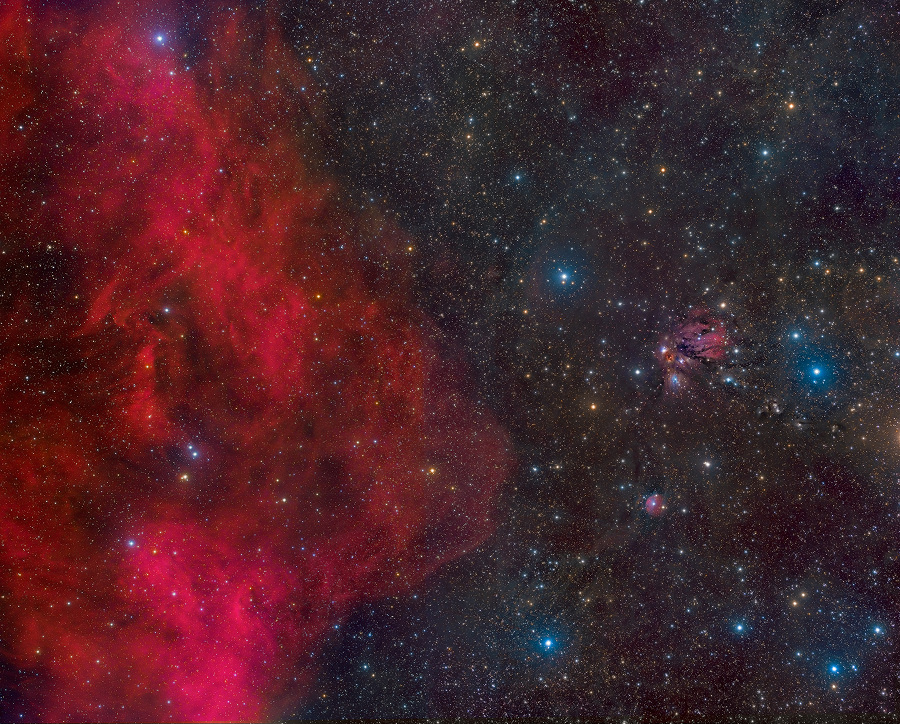
A gaze across a cosmic skyscape, this telescopic mosaic reveals the continuous beauty of things that are. The evocative scene spans some 6 degrees or 12 Full Moons in planet Earth's sky. At the left, folds of red, glowing gas are a small part of an immense, 300 light-year wide arc. Known as Barnard's loop, the structure is too faint to be seen with the eye, shaped by long gone supernova explosions and the winds from massive stars, and still traced by the light of hydrogen atoms. Barnard's loop lies about 1,500 light-years away roughly centered on the Great Orion Nebula, a stellar nursery along the edge of Orion's molecular clouds. But beyond lie other fertile star fields in the plane of our Milky Way Galaxy. At the right, the long-exposure composite finds NGC 2170, a dusty complex of nebulae near a neighboring molecular cloud some 2,400 light-years distant.