Nebula
A nebula is a giant cloud of gas (mostly hydrogen and helium) and cosmic dust situated between stars in the interstellar medium. Nebulae serve as sites of stellar birth and death—including emission nebulae that glow from ionized gas, reflection nebulae that scatter starlight, and dark nebulae that obscure background stars.
Source: science.nasa.gov
APODs including "Nebula"
The Eagle and The Swan
31/05/2013
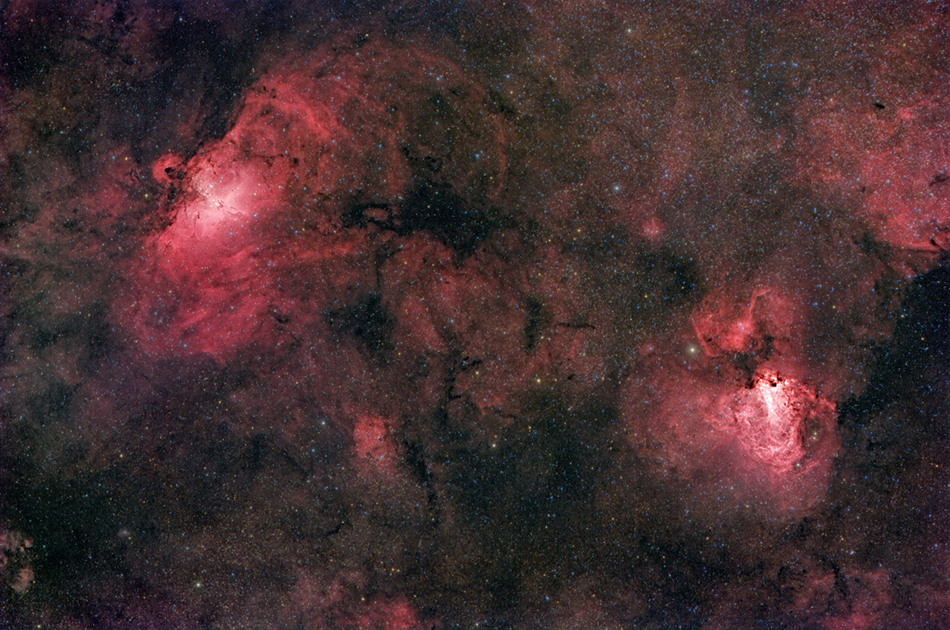
The Eagle Nebula and the Swan Nebula span this broad starscape, a telescopic view of the Sagittarius spiral arm toward the center of our Milky Way galaxy. The Eagle, also known as M16, is left, above center, and the Swan, or M17 at the lower right. The deep, wide-field image shows the cosmic clouds as brighter regions of active star-formation. They lie along the spiral arm suffused with reddish emission charactistic of atomic hydrogen gas, and dusty dark nebulae. In fact, the center of both nebulae are locations of well-known close-up images of star formation from the Hubble Space Telescope. M17, also called the Omega Nebula, is about 5500 light-years away, while M16 is some 6500 light-years distant. In the frame that covers 3 degrees across the sky, the extended wings of the Eagle Nebula are spread over 120 light-years.