Nebula
A nebula is a giant cloud of gas (mostly hydrogen and helium) and cosmic dust situated between stars in the interstellar medium. Nebulae serve as sites of stellar birth and death—including emission nebulae that glow from ionized gas, reflection nebulae that scatter starlight, and dark nebulae that obscure background stars.
Source: science.nasa.gov
APODs including "Nebula"
Cocoon Nebula Wide Field
18/09/2014
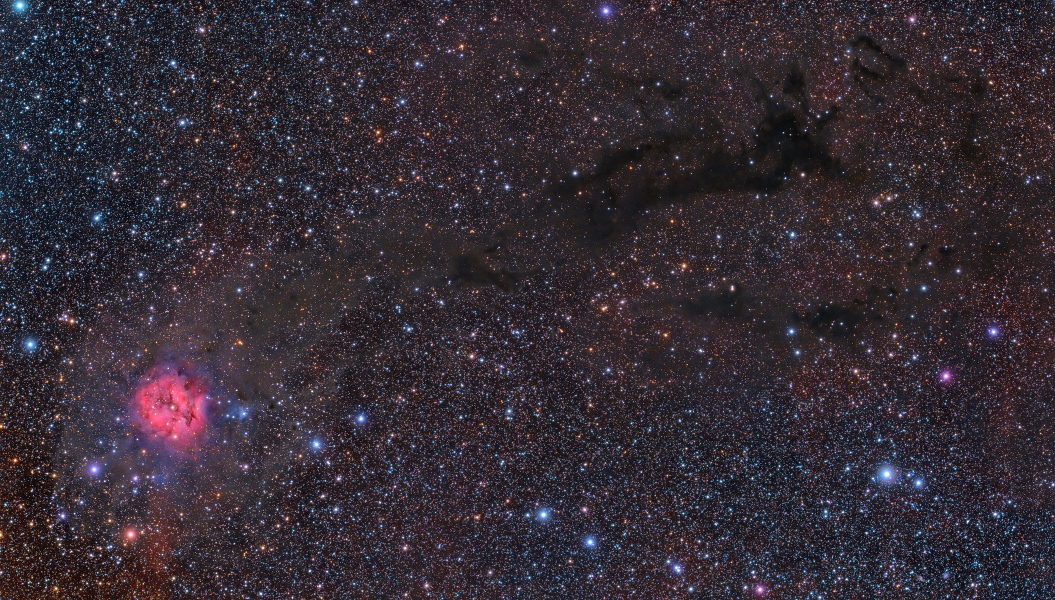
In this crowded starfield covering over 2 degrees within the high flying constellation Cygnus, the eye is drawn to the Cocoon Nebula. A compact star forming region, the cosmic Cocoon punctuates a long trail of obscuring interstellar dust clouds. Cataloged as IC 5146, the nebula is nearly 15 light-years wide, located some 4,000 light years away. Like other star forming regions, it stands out in red, glowing, hydrogen gas excited by the young, hot stars and blue, dust-reflected starlight at the edge of an otherwise invisible molecular cloud. In fact, the bright star near the center of this nebula is likely only a few hundred thousand years old, powering the nebular glow as it clears out a cavity in the molecular cloud's star forming dust and gas. But the long dusty filaments that appear dark in this visible light image are themselves hiding stars in the process of formation that can be seen seen at infrared wavelengths.