Nebula
A nebula is a giant cloud of gas (mostly hydrogen and helium) and cosmic dust situated between stars in the interstellar medium. Nebulae serve as sites of stellar birth and death—including emission nebulae that glow from ionized gas, reflection nebulae that scatter starlight, and dark nebulae that obscure background stars.
Source: science.nasa.gov
APODs including "Nebula"
The Flame Nebula in Visible and Infrared
09/12/2014
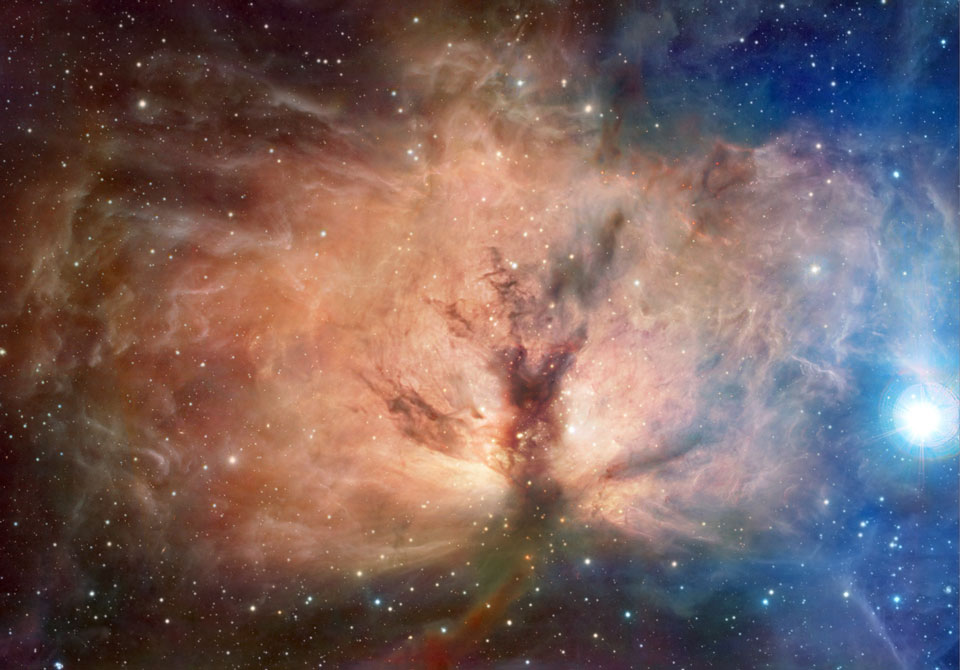
What lights up the Flame Nebula? Fifteen hundred light years away towards the constellation of Orion lies a nebula which, from its glow and dark dust lanes, appears, on the left, like a billowing fire. But fire, the rapid acquisition of oxygen, is not what makes this Flame glow. Rather the bright star Alnitak, the easternmost star in the Belt of Orion visible just to the right of the nebula, shines energetic light into the Flame that knocks electrons away from the great clouds of hydrogen gas that reside there. Much of the glow results when the electrons and ionized hydrogen recombine. The above false-color picture of the Flame Nebula (NGC 2024) was taken is a composite of both visible and infrared light, the later energy band being where a young star cluster becomes visible. The Flame Nebula is part of the Orion Molecular Cloud Complex, a star-forming region that includes the famous Horsehead Nebula. Astrophysicists: Browse 900+ codes in the Astrophysics Source Code Library