Nebula
A nebula is a giant cloud of gas (mostly hydrogen and helium) and cosmic dust situated between stars in the interstellar medium. Nebulae serve as sites of stellar birth and death—including emission nebulae that glow from ionized gas, reflection nebulae that scatter starlight, and dark nebulae that obscure background stars.
Source: science.nasa.gov
APODs including "Nebula"
Central Cygnus Skyscape
22/03/2017
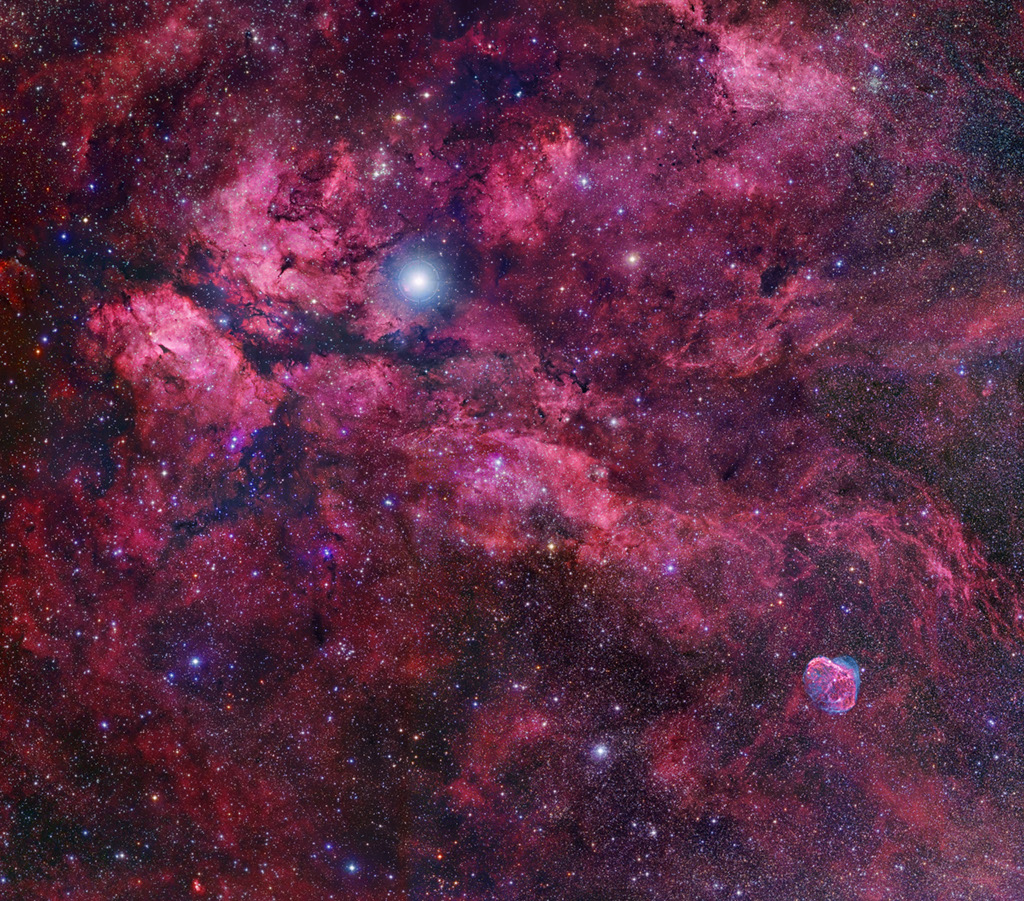
In cosmic brush strokes of glowing hydrogen gas, this beautiful skyscape unfolds across the plane of our Milky Way Galaxy near the northern end of the Great Rift and the center of the constellation Cygnus the Swan. A 36 panel mosaic of telescopic image data, the scene spans about six degrees. Bright supergiant star Gamma Cygni (Sadr) to the upper left of the image center lies in the foreground of the complex gas and dust clouds and crowded star fields. Left of Gamma Cygni, shaped like two luminous wings divided by a long dark dust lane is IC 1318 whose popular name is understandably the Butterfly Nebula. The more compact, bright nebula at the lower right is NGC 6888, the Crescent Nebula. Some distance estimates for Gamma Cygni place it at around 1,800 light-years while estimates for IC 1318 and NGC 6888 range from 2,000 to 5,000 light-years.