Nebula
A nebula is a giant cloud of gas (mostly hydrogen and helium) and cosmic dust situated between stars in the interstellar medium. Nebulae serve as sites of stellar birth and death—including emission nebulae that glow from ionized gas, reflection nebulae that scatter starlight, and dark nebulae that obscure background stars.
Source: science.nasa.gov
APODs including "Nebula"
A Sagittarius Triplet
27/07/2017
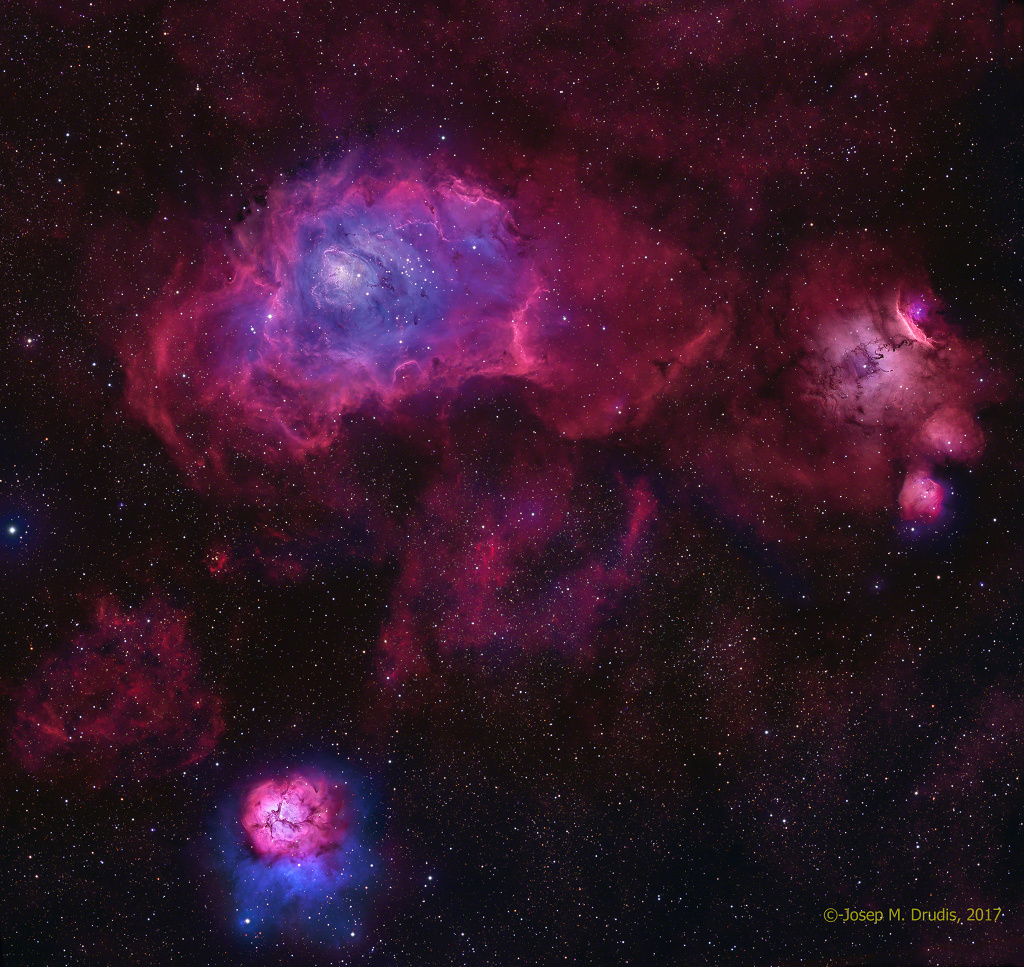
These three bright nebulae are often featured on telescopic tours of the constellation Sagittarius and the crowded starfields of the central Milky Way. In fact, 18th century cosmic tourist Charles Messier cataloged two of them; M8, the large nebula above and left of center, and colorful M20 near the bottom of the frame. The third emission region includes NGC 6559, right of M8 and separated from the larger nebula by a dark dust lane. All three are stellar nurseries about five thousand light-years or so distant. Over a hundred light-years across the expansive M8 is also known as the Lagoon Nebula. M20's popular moniker is the Trifid. Glowing hydrogen gas creates the dominant red color of the emission nebulae. In striking contrast, blue hues in the Trifid are due to dust reflected starlight. The colorful composite skyscape was recorded with two different telescopes to capture a widefield image of the area and individual close-ups at higher resolution.