Nebula
A nebula is a giant cloud of gas (mostly hydrogen and helium) and cosmic dust situated between stars in the interstellar medium. Nebulae serve as sites of stellar birth and death—including emission nebulae that glow from ionized gas, reflection nebulae that scatter starlight, and dark nebulae that obscure background stars.
Source: science.nasa.gov
APODs including "Nebula"
Vela Supernova Remnant Mosaic
10/01/2019
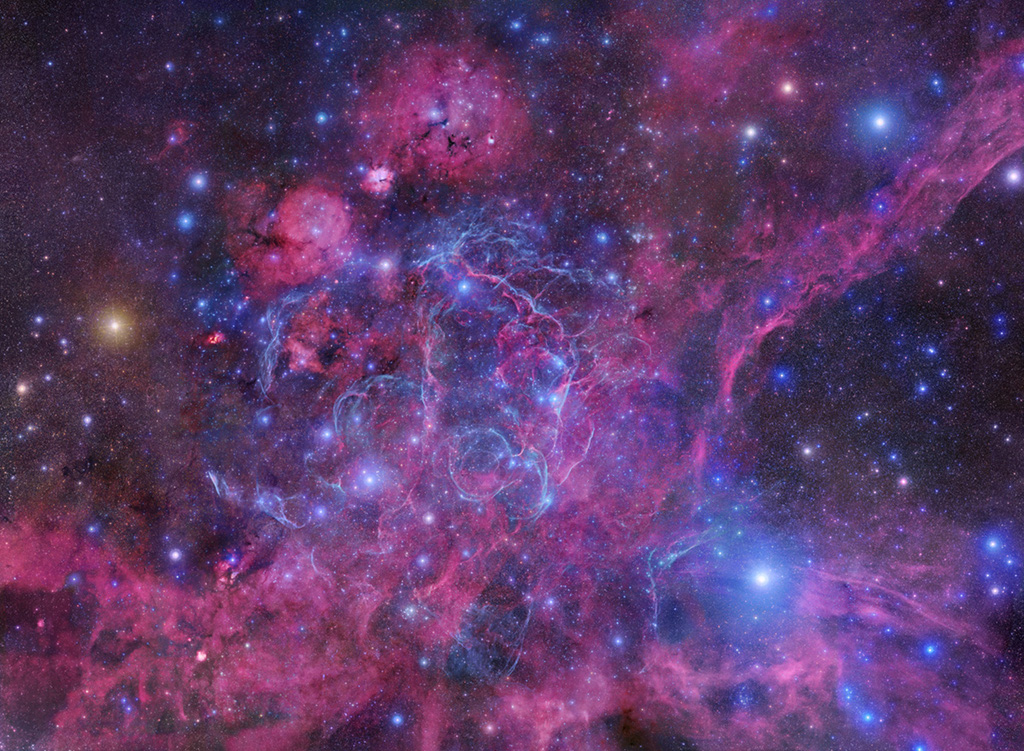
The plane of our Milky Way Galaxy runs through this complex and beautiful skyscape. Seen toward colorful stars near the northwestern edge of the constellation Vela (the Sails), the 16 degree wide, 200 frame mosaic is centered on the glowing filaments of the Vela Supernova Remnant, the expanding debris cloud from the death explosion of a massive star. Light from the supernova explosion that created the Vela remnant reached Earth about 11,000 years ago. In addition to the shocked filaments of glowing gas, the cosmic catastrophe also left behind an incredibly dense, rotating stellar core, the Vela Pulsar. Some 800 light-years distant, the Vela remnant is likely embedded in a larger and older supernova remnant, the Gum Nebula. Objects identified in this broad mosaic include emission and reflection nebulae, star clusters, and the remarkable Pencil Nebula.