Nebula
A nebula is a giant cloud of gas (mostly hydrogen and helium) and cosmic dust situated between stars in the interstellar medium. Nebulae serve as sites of stellar birth and death—including emission nebulae that glow from ionized gas, reflection nebulae that scatter starlight, and dark nebulae that obscure background stars.
Source: science.nasa.gov
APODs including "Nebula"
Orion over the Austrian Alps
23/01/2019
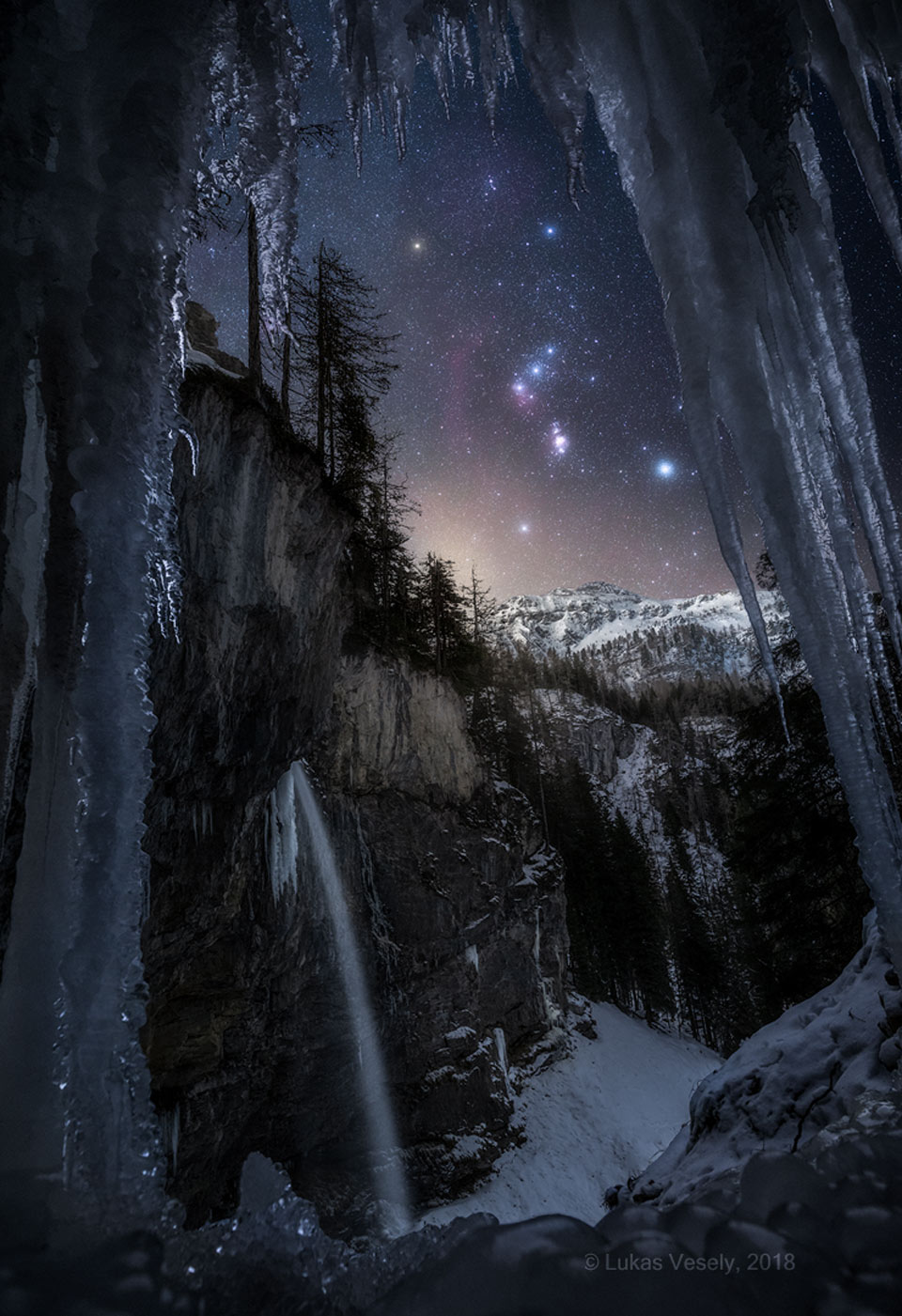
Do you recognize this constellation? Through the icicles and past the mountains is Orion, one of the most identifiable star groupings on the sky and an icon familiar to humanity for over 30,000 years. Orion has looked pretty much the same during the past 50,000 years and should continue to look the same for many thousands of years into the future. Orion is quite prominent in the sky this time of year, a recurring sign of (modern) winter in Earth's northern hemisphere and summer in the south. Pictured, Orion was captured recently above the Austrian Alps in a composite of seven images taken by the same camera in the same location during the same night. Below and slightly to the right of Orion's three-star belt is the Orion Nebula, while the four bright stars surrounding the belt are, clockwise from the upper left, Betelgeuse, Bellatrix, Rigel, and Saiph. New: Instagram page features cool images recently submitted to APOD