Nebula
A nebula is a giant cloud of gas (mostly hydrogen and helium) and cosmic dust situated between stars in the interstellar medium. Nebulae serve as sites of stellar birth and death—including emission nebulae that glow from ionized gas, reflection nebulae that scatter starlight, and dark nebulae that obscure background stars.
Source: science.nasa.gov
APODs including "Nebula"
Magnetic Orion
27/02/2019
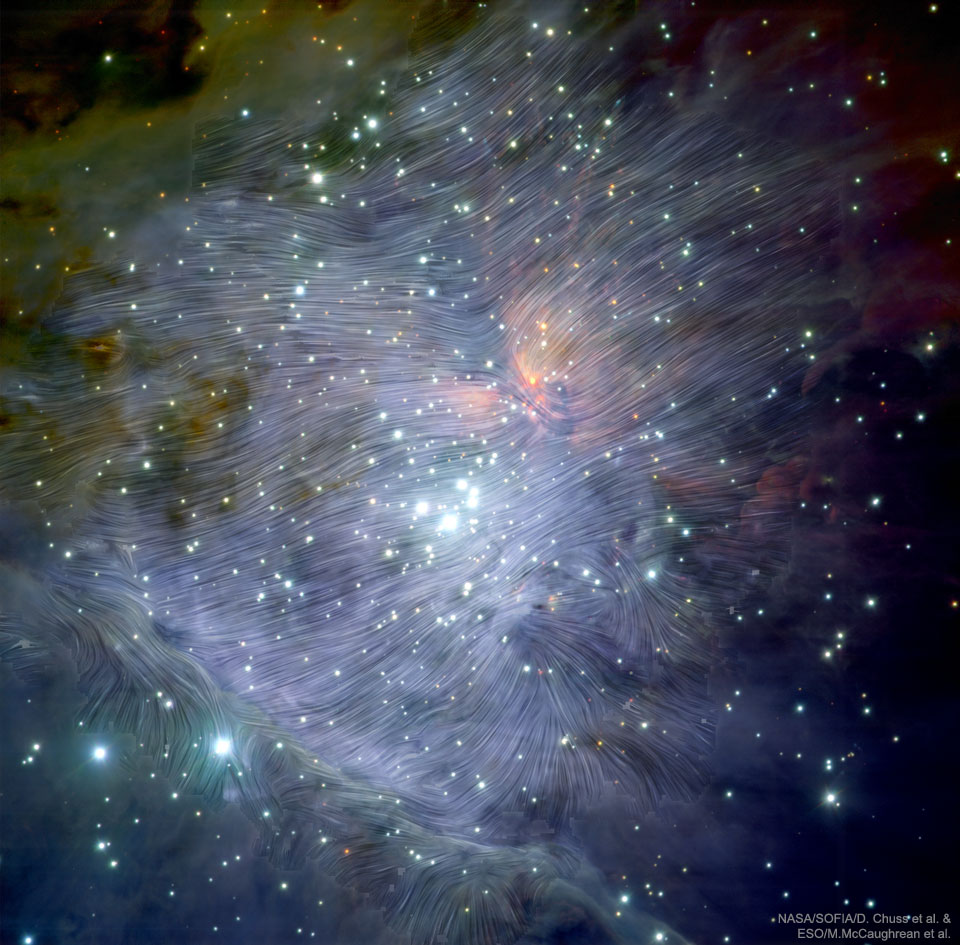
Can magnetism affect how stars form? Recent analysis of Orion data from the HAWC+ instrument on the airborne SOFIA observatory indicate that, at times, it can. HAWC+ is able to measure the polarization of far-infrared light which can reveal the alignment of dust grains by expansive ambient magnetic fields. In the featured image, these magnetic fields are shown as curvy lines superposed on an infrared image of the Orion Nebula taken by a Very Large Telescope in Chile. Orion's Kleinmann-Low Nebula is visible slightly to the upper right of the image center, while bright stars of the Trapezium cluster are visible just to the lower left of center. The Orion Nebula at about l300 light years distant is the nearest major star formation region to the Sun.