Nebula
A nebula is a giant cloud of gas (mostly hydrogen and helium) and cosmic dust situated between stars in the interstellar medium. Nebulae serve as sites of stellar birth and death—including emission nebulae that glow from ionized gas, reflection nebulae that scatter starlight, and dark nebulae that obscure background stars.
Source: science.nasa.gov
APODs including "Nebula"
The Iris Nebula in a Field of Dust
12/09/2019
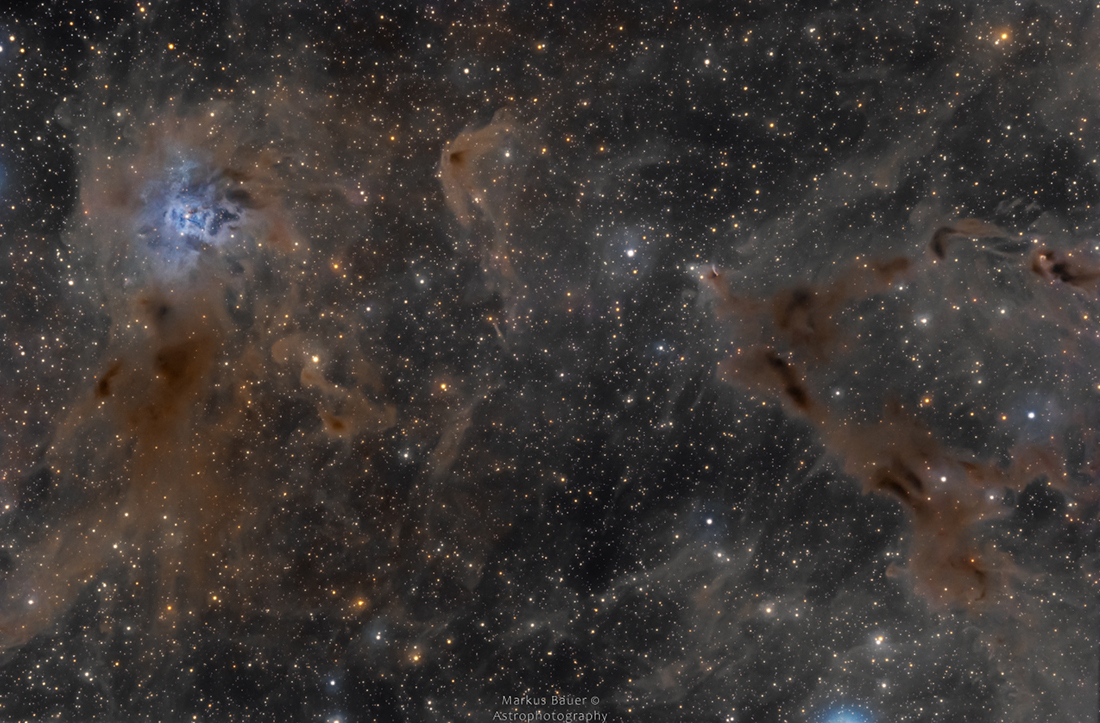
These cosmic dust clouds drift some 1,300 light-years away along the fertile starfields of the constellation Cepheus. The beautiful Iris Nebula, also known as NGC 7023, blossoms at the upper left. Not the only nebula in the sky to evoke the imagery of flowers, its pretty, symmetric form spans about 6 light-years. This nebula's dominant blue color is characteristic of the pervasive dust grains reflecting light from a nearby hot, bluish star. But darker, obscuring dust clouds cover most of the nearly 4 degree wide field of view. At the right is the LDN 1147/1158 complex of Lynds Dark Nebulae. Stars are forming there, still hidden within the dark cloud cores. A search through the sharp image can identify Herbig-Haro objects though, jets of shocked glowing gas emanating from recently formed stars.