Nebula
A nebula is a giant cloud of gas (mostly hydrogen and helium) and cosmic dust situated between stars in the interstellar medium. Nebulae serve as sites of stellar birth and death—including emission nebulae that glow from ionized gas, reflection nebulae that scatter starlight, and dark nebulae that obscure background stars.
Source: science.nasa.gov
APODs including "Nebula"
Molecular Clouds in the Carina Nebula
02/10/2019
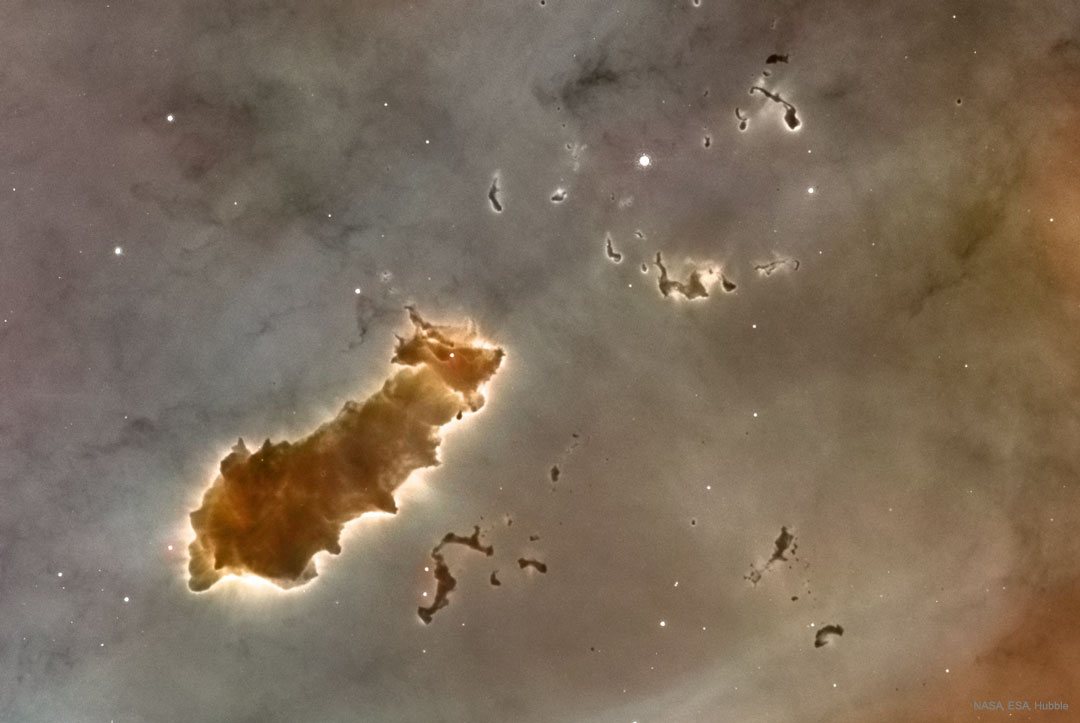
They are not alive -- but they are dying. The unusual forms found in the Carina nebula, a few of which are featured here, might best be described as evaporating. Energetic light and winds from nearby stars are breaking apart the dark dust grains that make the iconic forms opaque. Ironically the figures, otherwise known as dark molecular clouds or bright rimmed globules, frequently create in their midst the very stars that later destroy them. The floating space structures pictured here by the orbiting Hubble Space Telescope span a few light months. The Great Nebula in Carina itself spans about 30 light years, lies about 7,500 light years away, and can be seen with a small telescope toward the constellation of Keel(Carina).