Nebula
A nebula is a giant cloud of gas (mostly hydrogen and helium) and cosmic dust situated between stars in the interstellar medium. Nebulae serve as sites of stellar birth and death—including emission nebulae that glow from ionized gas, reflection nebulae that scatter starlight, and dark nebulae that obscure background stars.
Source: science.nasa.gov
APODs including "Nebula"
Carina Nebula Close Up
15/02/2020
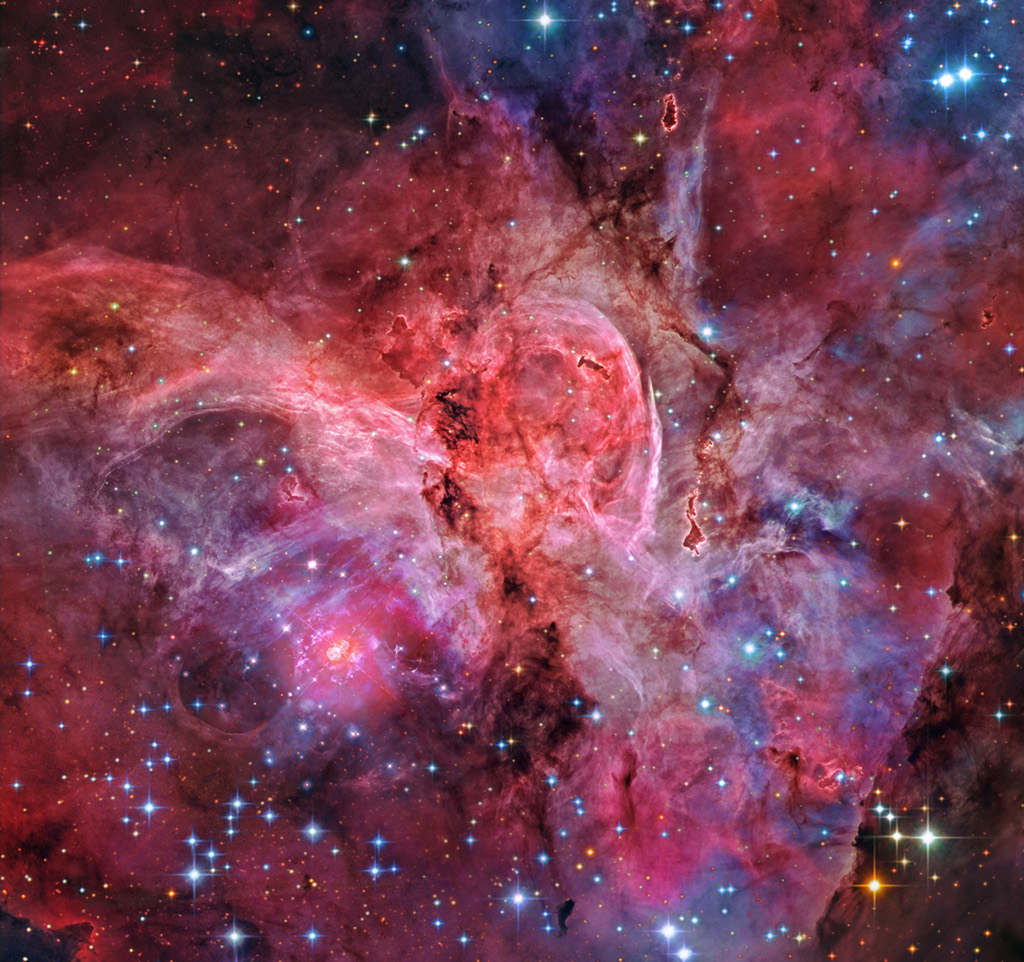
A jewel of the southern sky, the Great Carina Nebula, also known as NGC 3372, spans over 300 light-years, one of our galaxy's largest star forming regions. Like the smaller, more northerly Great Orion Nebula, the Carina Nebula is easily visible to the unaided eye, though at a distance of 7,500 light-years it is some 5 times farther away. This gorgeous telescopic close-up reveals remarkable details of the region's central glowing filaments of interstellar gas and obscuring cosmic dust clouds in a field of view nearly 20 light-years across. The Carina Nebula is home to young, extremely massive stars, including the still enigmatic and violently variable Eta Carinae, a star system with well over 100 times the mass of the Sun. In the processed composite of space and ground-based image data a dusty, two-lobed Homunculus Nebula appears to surround Eta Carinae itself just below and left of center. While Eta Carinae is likely on the verge of a supernova explosion, X-ray images indicate that the Great Carina Nebula has been a veritable supernova factory.