Nebula
A nebula is a giant cloud of gas (mostly hydrogen and helium) and cosmic dust situated between stars in the interstellar medium. Nebulae serve as sites of stellar birth and death—including emission nebulae that glow from ionized gas, reflection nebulae that scatter starlight, and dark nebulae that obscure background stars.
Source: science.nasa.gov
APODs including "Nebula"
Star Forming Region S106
25/03/2020
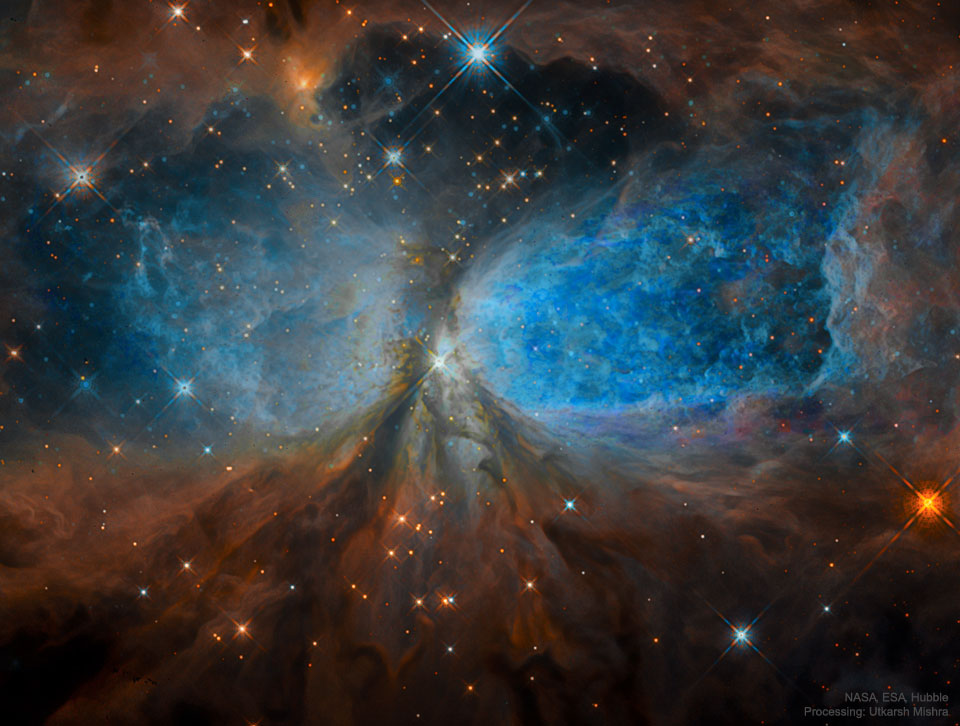
Massive star IRS 4 is beginning to spread its wings. Born only about 100,000 years ago, material streaming out from this newborn star has formed the nebula dubbed Sharpless 2-106 Nebula (S106), featured here. A large disk of dust and gas orbiting Infrared Source 4 (IRS 4), visible in brown near the image center, gives the nebula an hourglass or butterfly shape. S106 gas near IRS 4 acts as an emission nebula as it emits light after being ionized, while dust far from IRS 4 reflects light from the central star and so acts as a reflection nebula. Detailed inspection of a relevant infrared image of S106 reveal hundreds of low-mass brown dwarf stars lurking in the nebula's gas. S106 spans about 2 light-years and lies about 2000 light-years away toward the constellation of the Swan (Cygnus).