Nebula
A nebula is a giant cloud of gas (mostly hydrogen and helium) and cosmic dust situated between stars in the interstellar medium. Nebulae serve as sites of stellar birth and death—including emission nebulae that glow from ionized gas, reflection nebulae that scatter starlight, and dark nebulae that obscure background stars.
Source: science.nasa.gov
APODs including "Nebula"
Cygnus Without Stars
30/11/2020
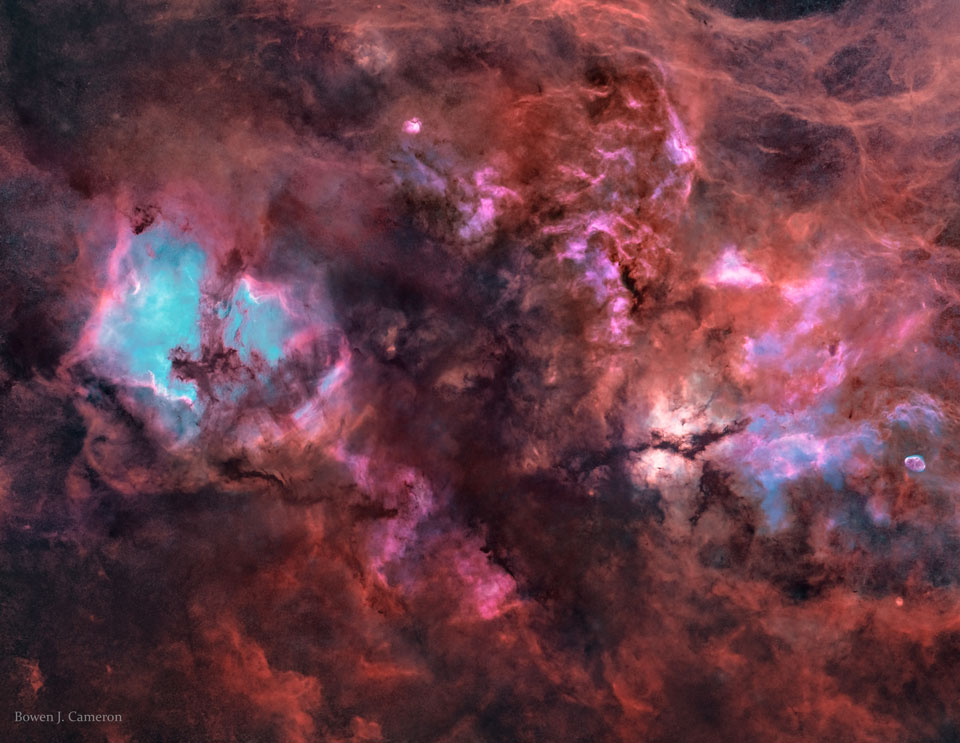
The sky is filled with faintly glowing gas, though it can take a sensitive camera and telescope to see it. For example, this twelve-degree-wide view of the northern part of the constellation Cygnus reveals a complex array of cosmic clouds of gas along the plane of our Milky Way galaxy. The featured mosaic of telescopic images was recorded through two filters: an H-alpha filter that transmits only visible red light from glowing hydrogen atoms, and a blue filter that transmits primarily light emitted by the slight amount of energized oxygen. Therefore, in this 18-hour exposure image, blue areas are hotter than red. Further digital processing has removed the myriad of point-like Milky Way stars from the scene. Recognizable bright nebulas include NGC 7000 (North America Nebula), and IC 5070 (Pelican Nebula) on the left with IC 1318 (Butterfly Nebula) and NGC 6888 (Crescent Nebula) on the right -- but others can be found throughout the wide field.