Nebula
A nebula is a giant cloud of gas (mostly hydrogen and helium) and cosmic dust situated between stars in the interstellar medium. Nebulae serve as sites of stellar birth and death—including emission nebulae that glow from ionized gas, reflection nebulae that scatter starlight, and dark nebulae that obscure background stars.
Source: science.nasa.gov
APODs including "Nebula"
NGC 346: Star Forming Cluster in the SMC
01/12/2020
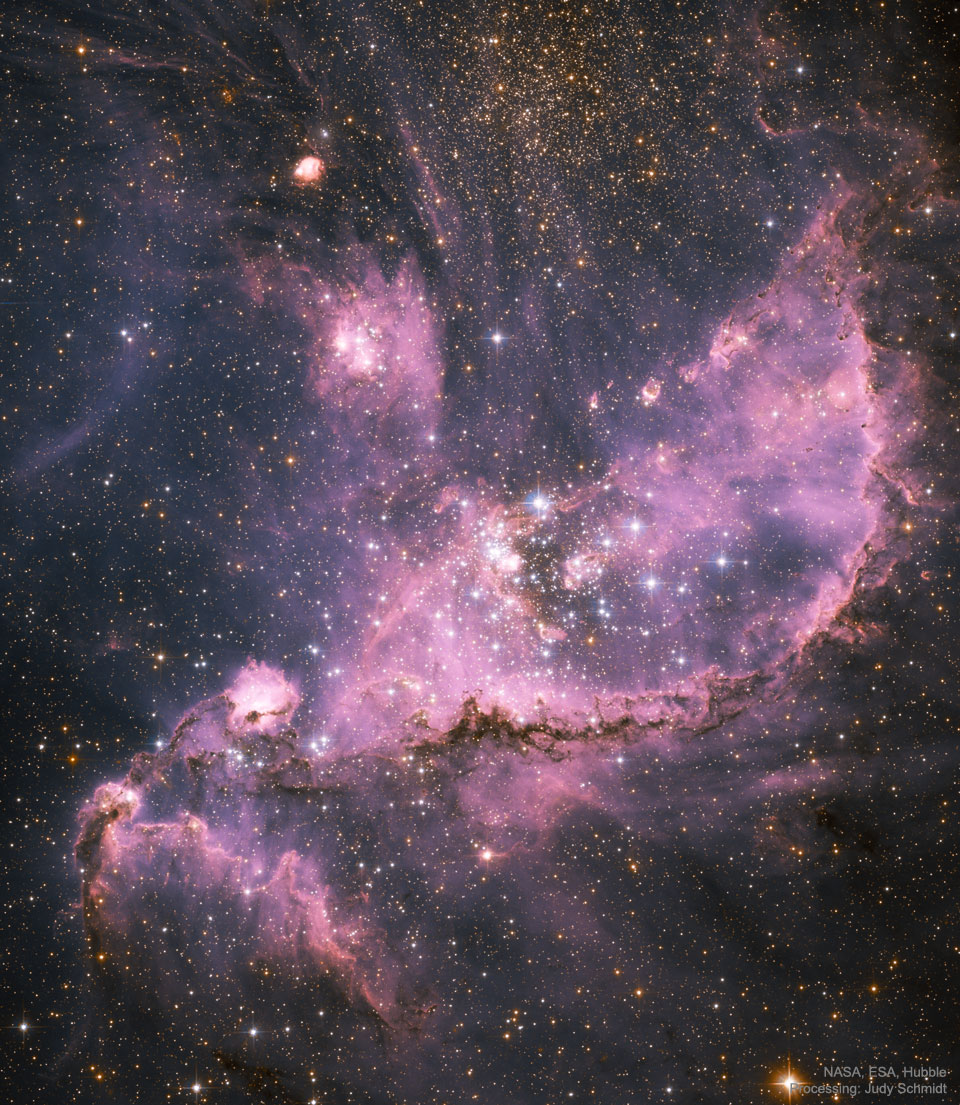
Are stars still forming in the Milky Way's satellite galaxies? Found among the Small Magellanic Cloud's (SMC's) clusters and nebulas, NGC 346 is a star forming region about 200 light-years across, pictured here in the center of a Hubble Space Telescope image. A satellite galaxy of the Milky Way, the Small Magellanic Cloud (SMC) is a wonder of the southern sky, a mere 210,000 light-years distant in the constellation of the Toucan (Tucana). Exploring NGC 346, astronomers have identified a population of embryonic stars strung along the dark, intersecting dust lanes visible here on the right. Still collapsing within their natal clouds, the stellar infants' light is reddened by the intervening dust. Toward the top of the frame is another star cluster with intrinsically older and redder stars. A small, irregular galaxy, the SMC itself represents a type of galaxy more common in the early Universe. These small galaxies, though, are thought to be building blocks for the larger galaxies present today. All 30: 2020 November APODs voiced by AI