Nebula
A nebula is a giant cloud of gas (mostly hydrogen and helium) and cosmic dust situated between stars in the interstellar medium. Nebulae serve as sites of stellar birth and death—including emission nebulae that glow from ionized gas, reflection nebulae that scatter starlight, and dark nebulae that obscure background stars.
Source: science.nasa.gov
APODs including "Nebula"
Central Lagoon in Infrared
19/03/2021
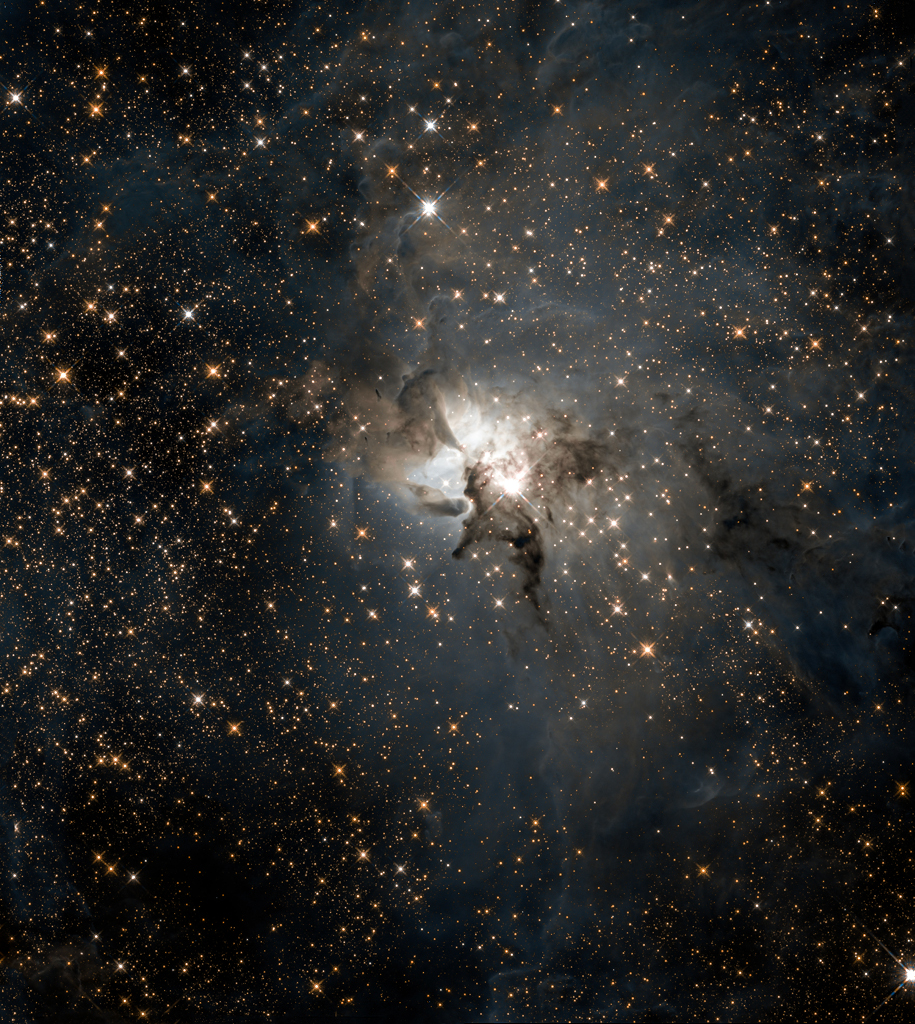
Stars fill this infrared view, spanning 4 light-years across the center of the Lagoon Nebula. Visible light images show the glowing gas and obscuring dust clouds that dominate the scene. But this infrared image, constructed from Hubble Space Telescope data, peers closer to the heart of the active star-forming region revealing newborn stars scattered within, against a crowded field of background stars toward the center of our Milky Way galaxy. This tumultuous stellar nursery's central regions are sculpted and energized by the massive, young Herschel 36, seen as the bright star near center in the field of view. Herschel 36 is actually a multiple system of massive stars. At over 30 times the mass of the Sun and less than 1 million years old, the most massive star in the system should live to a stellar old age of 5 million years. Compare that to the almost 5 billion year old Sun which will evolve into a red giant in only another 5 billion years or so. The Lagoon Nebula, also known as M8, lies about 4,000 light-years away within the boundaries of the constellation Sagittarius.