Nebula
A nebula is a giant cloud of gas (mostly hydrogen and helium) and cosmic dust situated between stars in the interstellar medium. Nebulae serve as sites of stellar birth and death—including emission nebulae that glow from ionized gas, reflection nebulae that scatter starlight, and dark nebulae that obscure background stars.
Source: science.nasa.gov
APODs including "Nebula"
The Southern Cliff in the Lagoon
15/05/2021
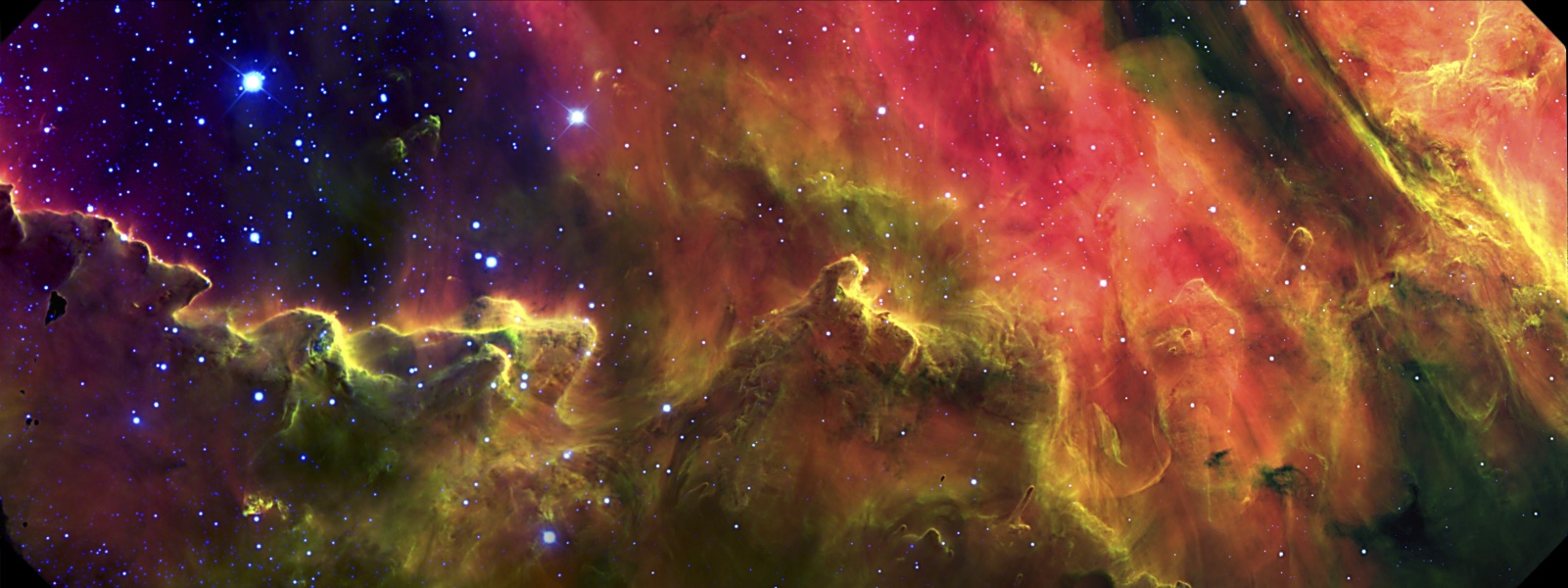
Undulating bright ridges and dusty clouds cross this close-up of the nearby star forming region M8, also known as the Lagoon Nebula. A sharp, false-color composite of narrow band visible and broad band near-infrared data from the 8-meter Gemini South Telescope, the entire view spans about 20 light-years through a region of the nebula sometimes called the Southern Cliff. The highly detailed image explores the association of many newborn stars imbedded in the tips of the bright-rimmed clouds and Herbig-Haro objects. Abundant in star-forming regions, Herbig-Haro objects are produced as powerful jets emitted by young stars in the process of formation heat the surrounding clouds of gas and dust. The cosmic Lagoon is found some 5,000 light-years away toward the constellation Sagittarius and the center of our Milky Way Galaxy. (For location and scale, check out this image superimposing the close-up of the Southern Cliff within the larger Lagoon Nebula. The scale image is courtesy R. Barba'.)