Nebula
A nebula is a giant cloud of gas (mostly hydrogen and helium) and cosmic dust situated between stars in the interstellar medium. Nebulae serve as sites of stellar birth and death—including emission nebulae that glow from ionized gas, reflection nebulae that scatter starlight, and dark nebulae that obscure background stars.
Source: science.nasa.gov
APODs including "Nebula"
From Orion to the Southern Cross
18/01/2022
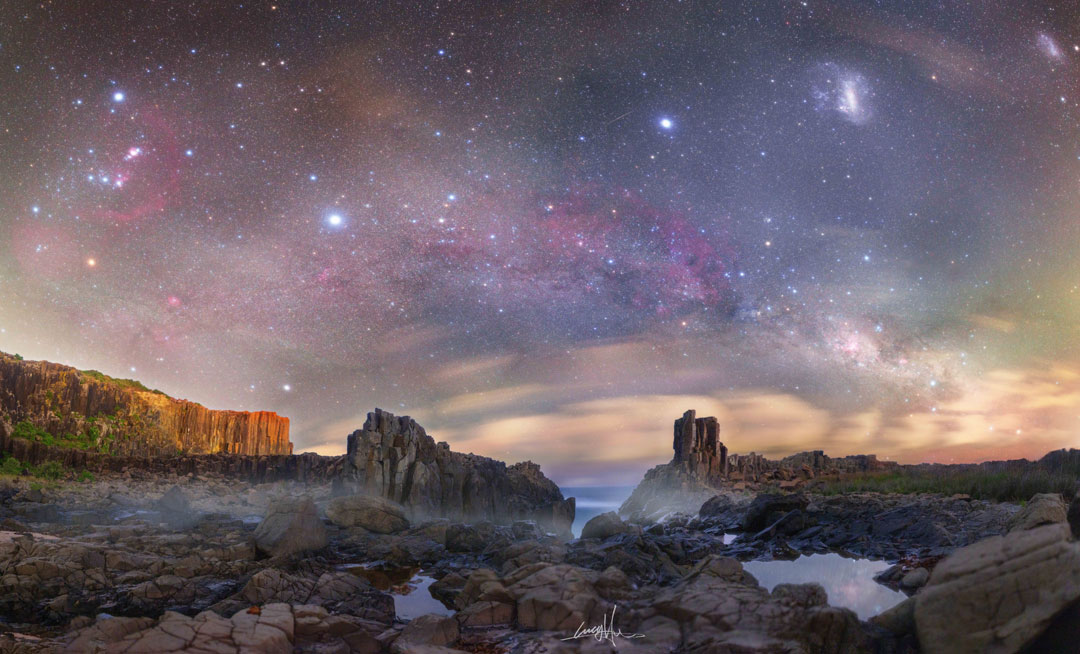
This is a sky filled with glowing icons. On the far left is the familiar constellation of Orion, divided by its iconic three-aligned belt stars and featuring the famous Orion Nebula, both partly encircled by Barnard's Loop. Just left of center in the featured image is the brightest star in the night: Sirius. Arching across the image center is the central band of our Milky Way Galaxy. On the far right, near the top, are the two brightest satellite galaxies of the Milky Way: the Large Magellanic Cloud (LMC), and the Small Magellanic Cloud (SMC). Also on the far right -- just above the cloudy horizon -- is the constellation of Crux, complete with the four stars that make the iconic Southern Cross. The featured image is a composite of 18 consecutive exposures taken by the same camera and from the same location in eastern Australia during the last days of last year. In the foreground, picturesque basalt columns of the Bombo Quarry part to reveal the vast Pacific Ocean.