Nebula
A nebula is a giant cloud of gas (mostly hydrogen and helium) and cosmic dust situated between stars in the interstellar medium. Nebulae serve as sites of stellar birth and death—including emission nebulae that glow from ionized gas, reflection nebulae that scatter starlight, and dark nebulae that obscure background stars.
Source: science.nasa.gov
APODs including "Nebula"
Barred Spiral Galaxy NGC 6217
21/02/2022
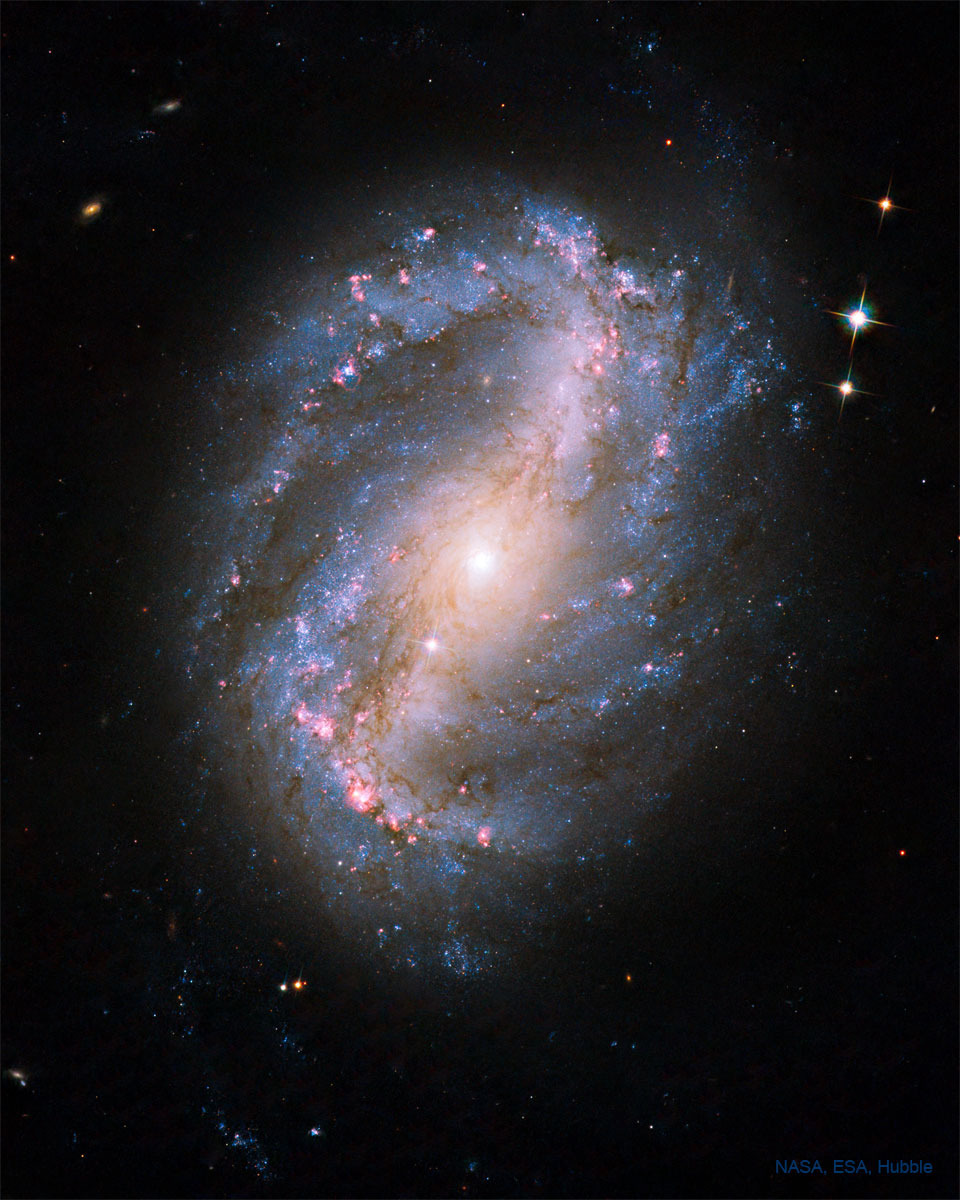
Many spiral galaxies have bars across their centers. Even our own Milky Way Galaxy is thought to have a modest central bar. Prominently barred spiral galaxy NGC 6217, featured here, was captured in spectacular detail in this image taken by the Advanced Camera for Surveys on the orbiting Hubble Space Telescope in 2009. Visible are dark filamentary dust lanes, young clusters of bright blue stars, red emission nebulas of glowing hydrogen gas, a long bar of stars across the center, and a bright active nucleus that likely houses a supermassive black hole. Light takes about 60 million years to reach us from NGC 6217, which spans about 30,000 light years across and can be found toward the constellation of the Little Bear (Ursa Minor). APOD in world languages: Arabic, Bulgarian, Catalan, Chinese (Beijing), Chinese (Taiwan), Croatian, Czech, Dutch, French, French (Canada), German, Hebrew, Indonesian, Japanese, Korean, Montenegrin, Polish, Russian, Serbian, Slovenian, Spanish, Taiwanese, Turkish, Turkish, and Ukrainian